Friday, September 11, 2009

Retirement Plan - ICICI Pru LifeStage Assure Pension

Nowadays so many peoples are worried about which Retirement Plans to take.

Here is a perfect example of financial companies taking investors for a grand ride.
Go to simpleinsurance.co.in for a chart of various investment/ insurance options from ICICI Prudential Life Insurance.

For example, consider the Retirement Plan (ICICI Pru LifeStage Assure Pension) by ICICI. For a 30 year old male, with an investment of Rs.2000 per month for 30 years, the plan with an optimistic 10% per annum growth rate will give a pension of Rs.15,315 per month for life from the 31st year onwards.


But are these plans good investment options?

Now here is the catch. All of these plans are unit linked. Any unit linked plan is confusing - with a variety a charges (asset allocation charge, fund management charge, mortality charge, etc.) deducted differently (either in terms units or deducting directly from the investment) at different times (at the beginning of the investment, monthly or yearly) and unpredictable growth rates (which are limited by the IRDA to 6% and 10% for illustration purposes). So each of these plans need to be evaluated in terms of their overall attractiveness.

How can these plans be evaluated?

The best way to evaluate investment/insurance plans is by separating the insurance (if bundled) and investment components. Compare the investment returns with that of a fixed deposit after adjusting best available rates for the bundled insurance (if any).

The Rs.15,315 pension per month for ICICI Pru Life Stage Assure Pension Plan looks impressive on a cursory glance, especially for an outlay of just Rs.2,000 per month.
Every thing is said in numbers – Agents will tell you that you have to pay only Rs 2000 /- per month for only 30 years and then you will receive Rs 15,315 per month for whole life. So at first glance this scheme looks awesome. Isn't it !!!

But let's have a closer look. Let us put the Rs.2,000 per month in a bank fixed deposit (FD) at a nominal 8% interest compounded annually. That makes Rs.24,000 annual investment in FD. For the next 30 years, let us assume that the interest rate remains constant at 8%. The Rs.24,000 per annum investment at 8% will accumulate to Rs.29.36 lakhs. You can even go with PPF account that also gives 8% tax-free returns. No need to say that PPF (Government of India) are the safest product in India. Even Supreme Court cannot attach any litigation to your PPF account as per constitution.

This amount (Rs.29.36 lakhs) if reinvested again after 30 years in FD at 8% interest will give annual interest of Rs.2.35 lakhs or a monthly interest of Rs.19,575 for life. Now compare this with the Rs.15,315 per month ICICI's Retirement Plan. The FD comprehensively beats the returns of ICICI by a massive Rs.4,260 per month (21.8% more). And don't forget that the FD or PPF return is more or less guaranteed where as ICICI's 10% return in risky and market dependent (it could be less, or more). Also, the accumulated Rs.29.36 lakhs is preserved for passing on to the next generation.
Means the monthly pension of Rs 19,575 is not only for you but also for your many-many generations to come. As it is coming from bank fixed deposit and not from some rubbish plan.

The case becomes even more compelling if we consider an SIP investment of Rs.2000 in a well-diversified large cap mutual fund for 30 years (which can give returns in excess of 10% per annum) and then putting the cumulative amount in an FD to draw pension for life at 8% per annum!

Mutual Fund Example:

If one invest 24,000 yearly (Rs 2000 monthly) at 10% per annum for 30 years.
Accumulated sum will be Rs 43,42,642 [ 43+ lacs ]
This amount if you keep in FD at 8% which will give you yearly return of Rs 3,47,411
Means you can withdraw monthly pension of Rs 28,950 /- [ 89% more that ICICI ]
Now compare this with ICICI’s pension amount of Rs 15,315

If you see the television add that ICICI Insurance company is showing you will think they are giving you double amount: Click here


So what's the verdict?

Isn't it obvious? In the above example a simple FD or a PPF (or mutual fund) would work much better than the pension plan by ICICI. The situation is not very different for the other plans either.

Investors need to be extremely cautious while selecting investment options. Insurance companies trick the investor emotions with children plans and retirement plans and misleading returns. They have devised clever ways to disguise costs and still work within the regulatory framework to (mis) sell insurance products. Deviating from their fundamental purpose (and duty) of selling insurance, most of these companies (including nationalized ones) have aggressively marketed and promoted bundled and complicated products. The profit sucked out of the investor's money goes as profit to the insurance company and as hefty commissions to insurance agents.

Conclusion
Never ever buy Retirement Plans / Children Plan / ULIP’s from such companies. Do you own calculations before buying any insurance plan. If you cannot do the calculation, mail me I will do it for you for FREE.

Thursday, September 3, 2009

Should I stay in a rented house or buy one ?

Another excellent article from Deepak Shenoy on "Should I rent a house or buy one ?"
The article has a link to get the excel sheet to calculate the difference between rented and self house w/ accrued gain/loss .
But I am attaching that excel sheet for your ready use.

Click here for Direct Link


The question one often asks when one gets to a comfortable state of personal affairs is: Should I rent a house or buy one?

All your friends are buying houses, or at least have "booked" them. There are good sentimental reasons to do so - owning a house ensures a tiny element of piece of mind - you can change things you don't like, like the drawers in your kitchen cabinet, or the paint on the walls, or add wooden flooring or a bathtub and such. But does it make financial sense to do this?

There are some advantages of each, but I shall take the Indian perspective. Here's where we are with Renting:

* Renting in India typically costs less than 3% of a house value. Meaning, if a house's market value is Rs. 50 lakhs, the rental will be around Rs. 15,000 per month.
* Tax breaks are available: Around 40% of your basic salary (or the rent, whichever is lower) is deductible from your taxable income.

But there are tax advantages for buying too. Here's where we are:

* Payments on Interest upto Rs. 150,000 per year is tax deductible.
* Principal repayments are tax free upto Rs. 100,000 per year. (Section 80C)

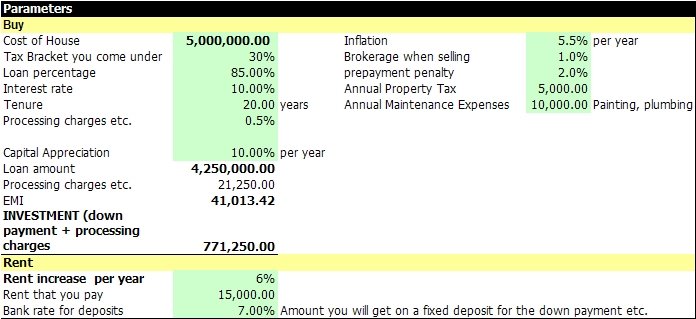
Let's see the comparison for a Rs. 50 Lakh house. I'm assuming that if you were to buy this house you will have a certain amount as "down payment" and pay a much higher EMI per month than the corresponding rent (Rs. 41,000 EMI, vs. Rs. 15,000 rent). If you rented, the extra money goes into the bank as a saving, and so does the down payment.


The return analysis on this, is in an excel sheet I have built, but here's the summary:


Key points to note:

* Cash flow wise, Renting is better for the first 8 years.
* After 8 years, buying is better, and after twenty years, the bought house is better by Rs. 1.4 crores!
* The equation is skewed to some extent because of the limits on the tax saving. The limit of Rs. 150,000 on the interest is too low - for the first 15 years, you pay more than 150,000 interest per year.
* Even the principal paid is more than 100,000 per year, so the tax saving there is limited too.

(Download the real estate calculator excel sheet)

If you're in for the long term you should buy, but remember this: If you think the prices will stabilize or come down in the next eight years, delay your decision to buy. After all, renting is far more cheaper and you will have much more money saved up in the longer term.

Also, be more aggressive in your investments to give you a better return, and therefore a better down payment.

Finally, remember that owning your house is important for sentimental and personal reasons too. The happiness you can derive from having an own house perhaps outweighs financial reasons.

Tuesday, September 1, 2009

Jeevan Tarang Policy from LIC

We will discuss about LIC's Jeevan Tarang Policy today and lets evaluate and answer the question "Is Jeevan Tarang worth consideration or Not" ?

Also see how can we beat this Policy by huge margin .

Jeevan Tarang Policy Highlights

* Jeevan Tarang is a Whole Life Plan from LIC , Whole life plan means that you are insured for whole life (max age 100) The plan offers three Accumulation periods – 10, 15 and 20 years. A proposer may choose any of them. This is the Tenure by when your Policy Matures.

* Whenever you die , you will get the Sum assured and then the Policy Expires . This policy will expire if you are at age 100 .

* If you Die before the Maturity , you will get the Sum Assured + All the Bonus Accumulated till date .

* The yearly Premium will depends on two things , your Tenure and your Age . It can range from 11% (Policy for 10 yrs) , 7-8% (Policy for 15 yrs) or 5-5.5% (policy for 20 yrs) .
For exact numbers see here. The percentages are with respect to your Sum Assured , 5.5% premium means 5.5% of your Sum assured . so Rs 10,00,000 of Sum assured means 55,000 of Premium each Year .

* Incase you survive till your Policy Tenure , then at the end of your Tenure , you will get Bonus accumulated (not the Sum assured) and an annuity of exact 5.5% each year after the Policy Matures . One will get 5.5% of the Sum Assured each year till his death or upto age 100 whichever is earlier .

* If you can not pay the Premiums and want to stop the policy (only after 3 yrs) , you have two choices , either make it a Paidup policy or take back the Surrender Value . This is explained in detail later , so move on .

* These are the main basic and approximate points of the Policy , for exact details see the policy page at LIC website .

Let us now see an example with different Scenario .This will help you understand it better.

Now let take Scenario's

Ajay's age is 30 and he takes Jeevan Tarang Policy for a tenure for 15 yrs with Sum Assured of Rs 10,00,000 (10 Lacs) . His Yearly Premiums will be 71.40 for every 1000 sum assured , which is 7.14% . Which comes to 71,400 per year .


If Ajay dies before 15 yrs


In this case he will get Sum Assured + Bonus Accumulated till date. The Bonus amount is not fixed and we can not tell how much it will be now , But on LIC webpage its mentioned in range of Rs 20-88 . Lets take a good figure of Rs 30 . In that case Per year it would be 30,000 more . So If he dies in 8th year , it would be 10 lacs (Sum Assured) + 2.4 lacs (bonus for 8 yrs) = 12.4 Lacs and the policy Expires .


If Ajay survives the Policy and does not die at all

In this case , Ajay will pay his premium upto 15 years and then in 15th year , he will get back the Bonus accumulated (not sum assured) , so may be it would be 4.5-5 lacs assuming Rs 30 as Bonus for every 1000 SA . Also he will get 55,000 per year(remember 5.5% of Sum Assured) as annuity till he dies or upto age 100 . He will also get Loyalty additions , this will again be a very small amount just like Bonus , but this is not assured at all .


If Ajay survives the Policy and Dies Later .


Its almost the same case as above , in this , Ajay will get Bonus at the end of 15 yrs and then He will start receiving 55,000 ever year . And suppose he dies before age 100 , he will receive the Sum Assured of Rs 10 lacs and that's it. The game is over and then LIC doesn't recognize him there after .

Ajay is not able to pay premiums because of some problem and wants to stop .

This is possible only after 3 yrs of taking the Policy , If he wants to stop it before 3 yrs , then sorry buddy , just forget your Money and go home cry . If its after 3 yrs , then He has two choices

* Make the Policy Paid up : In this case , you stop the Premium payments and you will get your Premiums and Bonus Accumulated will date at the end of the Maturity . You Sum assured will also reduce in Proportion to Premiums Paid, so if you stop the policy in 6th year , your Sum assured will reduce from 10 lacs to 4 lacs (40%) , as you have paid the premium only for 40% of the tenure (15 yrs) , that's 6 yrs .

* Take your Money Back : After 3 yrs of completion , the Policy acquires a Surrender value , generally its the Net Present Value of money in today's term what you are going to get at the end . See this post on Net Asset Value . So if you are going to get 5 lacs at the end of 15 yrs and today's worth of that money is 2 lacs , you will get 2 lacs today .


What is the Return of Jeevan Tarang Policy overall ?

Even if you receive all the annuity upto your age of 100 , the CAGR return for this policy using IRR Analysis comes to mere 4.72% . I have taken the above example and assumed 5 lacs of Bonus and no loyalty additions , even if we consider 7-8 lacs of Bonus and Some loyalty additions, the CAGR return does not cross 6% CAGR .


Why this Policy excites people and general people get fooled ?

These kind of Endowment policies make sure that you concentrate too much on numbers and it traps your mindset in the present moment , One who is able to foresee beyond "now" can understand the real value of these Policies .

We concentrate on numbers, If we get something for a long time and we pay for less time , it appeals to us , and hence this policy takes care of that very beautifully , You pay for 10 , 15 or 20 yrs and you get back till you are Age 100 , Sounds great !! .
Psychologically our mind is programmed by nature to think about the best case for our self , but how many of us will survive upto 100 yrs to get annuity back, The average person thinks emotionally , Insurance Companies work on Data , Statistics , Probability Theory and Complex calculations , which tell them that average person will die at 60-70 , and only 1-2 will survive till 100 years of their age .

Most of the people see Numbers and Present , The policy will demonstrate how much You will get at the end of the Maturity but it never tells you how much will it be worth then and how much will it help you in your Financial goals . We never think that Rs 100 today can buy much more than Rs 100 after 15 or 30 yrs . We know this somewhere inside us , but out mind just doesn't feel every time the same way , that's the reason you need to calculate things by hand , on paper or computer and do some small analysis like I did on this article . Then you get the clarity

Trust and Blind Faith , We trust companies because they have been in existence from long time and our parents were made to believe that these are the best friends in our life , they will protect our Future . Love and "Taking Endowment Policies" in India has similarity . I grew up hearing Love is Blind and experienced it too , and I feel that its same with Taking Endowment Polices . People just take it blindly , some new Policy comes up and bang !! , it has to be great , no matter what , because it comes from the GOD's own company !! . No one will concentrate on 4 important features of his portfolio and how that policy fits in.


What are the Limitations of the Policy

* Why age 100 ? How many people are going to live upto age 100 , why putting that number at 100 , why not increase it to 500 , even though life expectancy is just 60-70 . Not more than 1-2 in 100 live upto 100 .

* In case of Ajay , if his monthly expenses is 30,000 (considering married ,even though I doubt he will ever get any one) , after the accumulation period of 15 yrs , he will start receiving yearly pension of 55,000 per year , read it again , 55,000 per year , but now after 15 yrs , even with 6% of inflation his monthly expenses has gone upto 72,000 . And his policy pays him 55,000 which cannot even take care of his 1 month of expenses . Now i can see him pulling all his hairs .

* If he is dead at age 70 , His family would get back the Sum assured of 10 lacs and at that time , it can only pay for his family's 3-4 months of expenses and his Funeral cost , that's it .. Aha .. atleast something , so one this is confirmed , There will be no financial burden , pun intended .


Can we do better ?

This is the question which we should always ask in every situation of our life , not just Financial planning . Lets take care of Ajay's situation and plan him something better than Jeevan Tarang .

With Rs 71,600 per year to pay for 15 yrs , lets see what can we do .

First thing First , Lets cover his Family first from the Mishappenings of life an secure his dependents , Lets take a Term Insurance of 50 lacs for maximum tenure of 30 yrs , Premium would be close to 13k or 14k approx , lets assume 14k . So out of 71,600 , 14k is gone and we are left with 57,600 .

Now lets put 21,600 each year in PPF for 15 yrs . We are now left with 36,000 to invest , we will start Rs 3,000 SIP per month (Rs 1000 each in 3 different Equity funds) for 15 yrs .

PPF will accumulate to 6.3 lacs in 15 yrs and Mutual funds will accumulate to 15 lacs in 15 yrs assuming a pessimistic return of just 12% (Historical return has been more than 17% and last 5 yrs return are more than 25%) . Lets assume just 12% and not 18-20% even though its possible because our aim is to do better than Jeevan Tarang and achieve our goals and not compete with some one . So total amount will be around 21.3 lacs at the end of 15 yrs . Now lets visit and see our Scenario's again and hows does it compare now .

If Ajay dies before 15 yrs : Gets 50 lacs from Term Insurance and also the money from PPF and mutual funds , which will be more than 50 lacs :) . We beat Jeevan Tarang by huge margin in this case .

If Ajay survives and Does not Die at all : In this case he already has 21.3 lacs accumulated and now he can use this amount to buy an Annuity which will pay him more than 1.6 lacs Per year , much more than what he was getting in LIC policy . As a toppings , he also has a 50 lac cover for another 15 years . We can generate 3 times more annuity than Jeevan Astha here , again beat by huge margin .

If Ajay survives the Policy and Dies Later : In this case if he dies in next 15 yrs , his family would get 50 lacs from Insurance (10 lacs in LIC - Jeevan Tarang) , apart from this he will have his 21.3 lacs growing every year . If he dies after 15 more year , There will be no Insurance money , but his money would have grown a lot by now .. If he dies after 15 yrs (total 30 yrs from starting) , his money would have grown to 1.17 crores assuming 12% return per year (no annuity every year) . and if he dies after 25 years (total 40 yrs from starting , means at age 70) , his money would have grown to 6 crores . Now incase you don't want to faint , don't ask me how much would have he had if he lived till age 100 and left his money to grow , Its 13 crores :) . I have not assumed any annual annuity here , we can do that but the result would remain almost same . We beat Jeevan Tarang by hugest margin in this case .

Ajay is not able to pay premiums because of some problem and wants to stop .

His money will still be in PPF and Mutual funds and keep growing , there is no liquidity issue with Mutual funds , he can withdraw from mutual funds anytime ,even from PPF he can withdraw partially . If he has limited money , he can atleast pay his Insurance premiums and still get covered for 50 lacs , no big deal there . In every aspect it beats Jeevan Tarang

Note : For doing better than Jeevan Tarang we have invested in Mutual funds which are risky instruments , but anyways we are not in great position with Jeevan Tarang . so taking risk is worth it . If one is too concerned about risk , then even plain PPF will be better .

Conclusion : Think Logical , Think mathematical , Think smartly and atlast THINK !! .

Note : The figures have not considered the rebate provided by LIC , and hence the actual figures can deviate a bit from the actual numbers used here , but it wont be significant and the review still holds . ahh .. tired now !!

Sunday, August 30, 2009

Should you invest in Monthly Income Plans?

It's common for diversified equity funds to emerge as a top-of-the-mind investment when stock markets are booming. In such a scenario, hybrid funds like Balanced Funds and Monthly Income Plans (MIPs) are relegated to the sidelines. Investors can miss out on a very critical component in their portfolio by shutting out hybrid funds completely. Hybrid funds (powered by their flexibility to invest across asset classes) can add immense value to the investor's portfolio (especially during the down turn). While the role of balanced funds in the investor's portfolio has been well-documented, it is time for investors to sit up and recognise the value MIPs can add to their portfolio.

MIPs invest predominantly in debt instruments with a small portion of assets allocated to equities. The equity component provides MIPs with just the edge it needs to outperform conventional debt funds. The equity component usually varies between 5%-30% of assets. So under what circumstances would MIPs add value to an investor's portfolio? The graph below answers this question.

As is evident from the graph, during the crash in the stock markets last year, MIPs have fallen less as compared to the BSE Sensex indices. And this is where it adds value to an investor's portfolio. When the stock markets rally, they will lag conventional equity funds, but when the markets move down, they will limit the fall in an investor's portfolio.

Hence MIPs become important from an asset allocation perspective. Although, you can reach the desired asset allocation by allocating the assets in equity and debt; MIPs offer a convenient way of achieving the same.

Time to cash out?


Though the stock markets continue to be volatile, they have recovered from the lows touched in March this year. The markets have posted a growth of around 93% (as on August 26, 2009) since March 8, 2009. Expectedly, many investors who have lost a huge chunk of their invested corpus in the stock market crash last year are now eager to recover whatever they can. Now the question is - is it the right time for you to cash out? While you would promptly say YES, at Personal FN we have a contrarian view on this.

Sensex: Rise of the fallen

Broadly, there could be two reasons for making investments. First, and the most ideal reason, is to invest for the purpose of meeting one or more of your future goals/objectives. Second, and unfortunately the most commonly practiced, is to make "quick bucks" by participating in market movements. The latter option amounts to timing the markets, something that many investors try to do, but rarely succeed.

In our view, redeeming investments should not be a function of market movements, but rather a result of the following:

1. Redeem if you are sure that the fund in question has failed to meet its purpose in your financial plan. The reasons behind this could include poor performance or change in investment mandate of the fund, which makes it a misfit in your portfolio.
2. Redeem if you have to rebalance your asset allocation. Also,before you cash out, make sure that you have decided where to reinvest the redemtpion proceeds.
3. Redeem when you have achieved your investment objective.

Financing Avenues available for Studying Abroad


If you aspire to study abroad and are looking to fund your education, then this piece is for you. Financial aid, education loans and bursaries are the broad categories of finances available to students aspiring to study overseas.

Financial aid primarily comprises of scholarships offered by governments, universities, corporates and charitable trusts. Generally, exceptionally intelligent students qualify for such scholarships. Students who wish to apply for university scholarships have the opportunity to do so at the time of applying for the course. For example, HSBC offers two scholarships for students with guaranteed admission in Oxford, Cambridge and London Universities. Applications for these are accepted between April and June, every year.

Bursaries are endowments given to students based on financial need, and are used to supplement the student's primary source of funding. While this will be a starting point, it would bring down the requirement for funds to some extent.

Education loans are granted by banks and many private institutions (like the JN Tata Endowment for Higher Education of Indians). Education loans offered by banks normally have interest rates in the range of 11%-13% p.a., along with strict norms and collateral requirements for overseas degrees. The repayment period is normally between 5-7 years, and starts after completion of the education or 6 months after securing a job, whichever is earlier.

If a student is not able to get a scholarship and is short on funds, then he has no other option than to opt for an education loan. Although financing avenues have increased nowadays, it is imperative that students take the initiative to research the various funding options available to them and ensure that it meets their requirements.
Where to invest: Liquid Funds...Liquid Plus Funds...or Bank FDs


Liquid funds with no entry and exit loads and practically no credit risk, have not only been popular with banks and companies to park their short term money, but have also emerged as stiff competition to the savings bank a/c. For the past few years, post-tax returns from liquid funds have been in the range of 5%-6% p.a. making them a hit among individual investors especially the high net worth investors (HNIs). However, liquid funds are fast losing their edge over the savings bank a/c with average returns dropping to 3.5% p.a. This is mainly on account of the decline in short-term interest rates and the SEBI guideline restricting these funds from investing in any security having a residual maturity of more than 91 days. The average maturity period of most of these funds ranges from 50 to 60 days.

Is there an alternative to liquid funds? Yes, investors can consider investing their money in ultra short bond funds (erstwhile liquid plus funds). These funds can invest in securities with higher maturities and hence are able to generate returns which are 50-80 basis points higher than liquid funds. However, these extra returns come with slightly higher interest rate risk and credit risk. Most of these funds also have a lock-in period of at least 7 days. The average maturity period of these funds ranges from 140-150 days.

There is yet another option for individual investors. Of late banks have been offering a facility to transfer the money sitting idle in savings bank a/c to fixed deposits. The rate of fixed deposit is however, slightly less than the rate of a conventional FD for similar maturity.

The beauty of this facility is that the money lying in the fixed deposits is not subject to any kind of lock-in i.e. the investor can withdraw the money as and when required either through the ATM or by issuing a cheque without any penalty for premature withdrawal. Moreover, if the interest rates move up, money can be moved from lower interest rate FDs to higher interest rate FDs without any penalty. To top it up, the amount can be transferred either online or through simple instructions on the phone using the ATM/debit card number and the PIN. We urge investors to check with their bank for any such facility and if it does exist go for it NOW. After all, opportunity only knocks once!