Key to Excellent Financial Planning is Early Investing
Today's article is my favorite , Today we will see that what is the biggest secret of Generating Long term Wealth . Most of the people run after choosing great Mutual fund and choosing right policy , but they do not understand the most important element of Investment Planning , which is Early Investing . In this article we will discuss how important is Early Investing , We will see that what you contribute early in your Life is what matters the most .
I did some Excel calculations and found out some important Rules you should remember . All the Examples in this articles assumes 12% or 15% CAGR annual return over long term (30+ yrs) . Lets see some Important Ideas you should keep in Mind .
If you are reading this article in Email , you wont see important charts and graphs , make sure you visit the blog for this particular post . thanks
The amount you invest does not increase drastically when you cut your Tenure by huge Margin .
What I mean to say here is that if you have a goal of generating a fixed amount at the end of a long period like 30 yrs and If there are two cases
Case 1 : You invest amount A per month for 10 yrs and then let it grow for next 20 yrs .
Case 2 : You invest amount B per month for all 30 years .
In this case amount A will be too big compared to amount B . It would definitely be more , not by great extent . Lets take an example . If you want to generate a corpus of 2 crores in 30 yrs and you assume a return of 12% annually . You need to invest Rs 5666 per month to achieve this target if you can invest for whole 30 yrs . But what if you want to invest only for 20 yrs or 15 yrs ? In that case how much money you need to invest per month ? The answer is Rs 6065 (20 yrs) and Rs 6611 (15 yrs) . So you can see that the monthly contribution required to meet the same goal does not increase drastically even if you reduce the tenure by 10 or 15 yrs . See the chart below
The Tenure and amount required are :
30 yrs : 5666
25 yrs : 5801
20 yrs : 6065
15 yrs : 6611
10 yrs : 7903
In the above chart you can see how "Monthly Contribution Required" increase at very small amount if you want to save the investing years later in your Life . Download this Monthly Contribution Calculator to calculate how much you need to invest monthly for your Financial Goals.
Even if you cut your Contribution at the end of the Tenure , It wont affect the final Corpus Drastically .
What this means is that If you want to invest for long term and in case you are not able to invest for many years at the end , the final amount generated will not be drastically less .. The difference will not be worth a concern .
Lets see an example , If you want to invest Rs 4000 per month for next 30 yrs and you assume 15% annual CAGR return , you would be able to generate a corpus would be 2.8 crores , But in case you just invest for 20 yrs and don't invest for rest 10 yrs , in that case your corpus will still be 2.69 crores , 96% of the original amount . If you invest for 10 yrs and don't do anything for 20 yrs , still you will be left with 2.19 crores . You can see that how your corpus is not getting affected a lot because of laziness in investing . If you are successful in early investing , your 90% job is done , even if you are not able to invest money in later years , your final amount will not be affected a lot . See the chart Below .
If you see the chart above , you can clearly see that in the first 15 yrs , the total corpus at the end does not decrease with great rate . Its more than 2 crores even if you miss 22 yrs (thats more than 70% of total tenure) .
Investments Done in Initial years are the main chunk of your Final Corpus
What this means is that what you in the start has major chunk in your final corpus , the money you invest at the end generally has no major contribution because the money compounding has done its work on the money you invested in the start , not end . See the chart below .
The time frame of this example is 30 yrs investment with assumption of 12% annual CAGR return . You can see two kind of lines here . Blue Line shows contribution of a particular year in the final corpus and Red line shows cumulative share of years till then in the final corpus . If you see the chart and concentrate on 6th yr, you will realise that what ever you invested till 6th yrs contributes to 52% share of your Final corpus which means that if you stop at 6th year , you will still be able to make 52% of original amount .
You can also see that last 12 yrs contribution helps in 10% of final corpus, this we saw in the first chart itself . So at the end , lets see some numerical facts which will help us understand power of early investing .
"Investing 1500 per month for 10 yrs and letting it grow for next 20 yrs" will generate more than "Investing 1000 per month for 30 yrs" @12% return .
"If your Original time frame was 30 yrs and later you want to cut your Tenure by 50% , you corpus will decrease just by 14%" @12% return .
A : "Investing 5000 per month for 30 yrs" B : "Investing 6,000 per month for 15 yrs and do nothing for next 15 yrs" C : "Investing 11,000 per month for just 5 yrs and do nothing for next 25 yrs" Here , C will make 1.95 crores <>
If you are a young person below 25 and you have 35 yrs in your hand and want to make 5 crores , If you start right now , you will have to invest just Rs 3,400 per month , But if you are later by 10 yrs , then you will have to invest more than 15,000 per month to achieve same target .
Conclusion
Start Early , The secret of Sound Financial Planning is Early Investing , not making excellent return or choosing great funds or buying multibagger stocks . If you can take little pain and invest more money now , then better do it , It will save you from lot of trouble later .
Thursday, September 17, 2009

Friday, September 11, 2009
Retirement Plan - ICICI Pru LifeStage Assure Pension
Nowadays so many peoples are worried about which Retirement Plans to take.
Here is a perfect example of financial companies taking investors for a grand ride.
Go to simpleinsurance.co.in for a chart of various investment/ insurance options from ICICI Prudential Life Insurance.
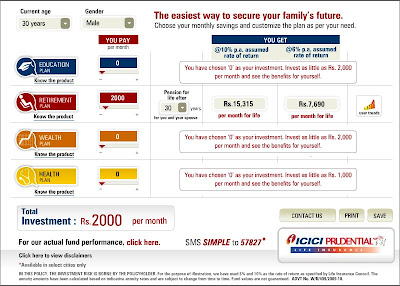
For example, consider the Retirement Plan (ICICI Pru LifeStage Assure Pension) by ICICI. For a 30 year old male, with an investment of Rs.2000 per month for 30 years, the plan with an optimistic 10% per annum growth rate will give a pension of Rs.15,315 per month for life from the 31st year onwards.
But are these plans good investment options?
Now here is the catch. All of these plans are unit linked. Any unit linked plan is confusing - with a variety a charges (asset allocation charge, fund management charge, mortality charge, etc.) deducted differently (either in terms units or deducting directly from the investment) at different times (at the beginning of the investment, monthly or yearly) and unpredictable growth rates (which are limited by the IRDA to 6% and 10% for illustration purposes). So each of these plans need to be evaluated in terms of their overall attractiveness.
How can these plans be evaluated?
The best way to evaluate investment/insurance plans is by separating the insurance (if bundled) and investment components. Compare the investment returns with that of a fixed deposit after adjusting best available rates for the bundled insurance (if any).
The Rs.15,315 pension per month for ICICI Pru Life Stage Assure Pension Plan looks impressive on a cursory glance, especially for an outlay of just Rs.2,000 per month.
Every thing is said in numbers – Agents will tell you that you have to pay only Rs 2000 /- per month for only 30 years and then you will receive Rs 15,315 per month for whole life. So at first glance this scheme looks awesome. Isn't it !!!
But let's have a closer look. Let us put the Rs.2,000 per month in a bank fixed deposit (FD) at a nominal 8% interest compounded annually. That makes Rs.24,000 annual investment in FD. For the next 30 years, let us assume that the interest rate remains constant at 8%. The Rs.24,000 per annum investment at 8% will accumulate to Rs.29.36 lakhs. You can even go with PPF account that also gives 8% tax-free returns. No need to say that PPF (Government of India) are the safest product in India. Even Supreme Court cannot attach any litigation to your PPF account as per constitution.
This amount (Rs.29.36 lakhs) if reinvested again after 30 years in FD at 8% interest will give annual interest of Rs.2.35 lakhs or a monthly interest of Rs.19,575 for life. Now compare this with the Rs.15,315 per month ICICI's Retirement Plan. The FD comprehensively beats the returns of ICICI by a massive Rs.4,260 per month (21.8% more). And don't forget that the FD or PPF return is more or less guaranteed where as ICICI's 10% return in risky and market dependent (it could be less, or more). Also, the accumulated Rs.29.36 lakhs is preserved for passing on to the next generation.
Means the monthly pension of Rs 19,575 is not only for you but also for your many-many generations to come. As it is coming from bank fixed deposit and not from some rubbish plan.
The case becomes even more compelling if we consider an SIP investment of Rs.2000 in a well-diversified large cap mutual fund for 30 years (which can give returns in excess of 10% per annum) and then putting the cumulative amount in an FD to draw pension for life at 8% per annum!
Mutual Fund Example:
If one invest 24,000 yearly (Rs 2000 monthly) at 10% per annum for 30 years.
Accumulated sum will be Rs 43,42,642 [ 43+ lacs ]
This amount if you keep in FD at 8% which will give you yearly return of Rs 3,47,411
Means you can withdraw monthly pension of Rs 28,950 /- [ 89% more that ICICI ]
Now compare this with ICICI’s pension amount of Rs 15,315
If you see the television add that ICICI Insurance company is showing you will think they are giving you double amount: Click here
So what's the verdict?
Isn't it obvious? In the above example a simple FD or a PPF (or mutual fund) would work much better than the pension plan by ICICI. The situation is not very different for the other plans either.
Investors need to be extremely cautious while selecting investment options. Insurance companies trick the investor emotions with children plans and retirement plans and misleading returns. They have devised clever ways to disguise costs and still work within the regulatory framework to (mis) sell insurance products. Deviating from their fundamental purpose (and duty) of selling insurance, most of these companies (including nationalized ones) have aggressively marketed and promoted bundled and complicated products. The profit sucked out of the investor's money goes as profit to the insurance company and as hefty commissions to insurance agents.
Conclusion
Never ever buy Retirement Plans / Children Plan / ULIP’s from such companies. Do you own calculations before buying any insurance plan. If you cannot do the calculation, mail me I will do it for you for FREE.
Here is a perfect example of financial companies taking investors for a grand ride.
Go to simpleinsurance.co.in for a chart of various investment/ insurance options from ICICI Prudential Life Insurance.
For example, consider the Retirement Plan (ICICI Pru LifeStage Assure Pension) by ICICI. For a 30 year old male, with an investment of Rs.2000 per month for 30 years, the plan with an optimistic 10% per annum growth rate will give a pension of Rs.15,315 per month for life from the 31st year onwards.

But are these plans good investment options?
Now here is the catch. All of these plans are unit linked. Any unit linked plan is confusing - with a variety a charges (asset allocation charge, fund management charge, mortality charge, etc.) deducted differently (either in terms units or deducting directly from the investment) at different times (at the beginning of the investment, monthly or yearly) and unpredictable growth rates (which are limited by the IRDA to 6% and 10% for illustration purposes). So each of these plans need to be evaluated in terms of their overall attractiveness.
How can these plans be evaluated?
The best way to evaluate investment/insurance plans is by separating the insurance (if bundled) and investment components. Compare the investment returns with that of a fixed deposit after adjusting best available rates for the bundled insurance (if any).
The Rs.15,315 pension per month for ICICI Pru Life Stage Assure Pension Plan looks impressive on a cursory glance, especially for an outlay of just Rs.2,000 per month.
Every thing is said in numbers – Agents will tell you that you have to pay only Rs 2000 /- per month for only 30 years and then you will receive Rs 15,315 per month for whole life. So at first glance this scheme looks awesome. Isn't it !!!
But let's have a closer look. Let us put the Rs.2,000 per month in a bank fixed deposit (FD) at a nominal 8% interest compounded annually. That makes Rs.24,000 annual investment in FD. For the next 30 years, let us assume that the interest rate remains constant at 8%. The Rs.24,000 per annum investment at 8% will accumulate to Rs.29.36 lakhs. You can even go with PPF account that also gives 8% tax-free returns. No need to say that PPF (Government of India) are the safest product in India. Even Supreme Court cannot attach any litigation to your PPF account as per constitution.
This amount (Rs.29.36 lakhs) if reinvested again after 30 years in FD at 8% interest will give annual interest of Rs.2.35 lakhs or a monthly interest of Rs.19,575 for life. Now compare this with the Rs.15,315 per month ICICI's Retirement Plan. The FD comprehensively beats the returns of ICICI by a massive Rs.4,260 per month (21.8% more). And don't forget that the FD or PPF return is more or less guaranteed where as ICICI's 10% return in risky and market dependent (it could be less, or more). Also, the accumulated Rs.29.36 lakhs is preserved for passing on to the next generation.
Means the monthly pension of Rs 19,575 is not only for you but also for your many-many generations to come. As it is coming from bank fixed deposit and not from some rubbish plan.
The case becomes even more compelling if we consider an SIP investment of Rs.2000 in a well-diversified large cap mutual fund for 30 years (which can give returns in excess of 10% per annum) and then putting the cumulative amount in an FD to draw pension for life at 8% per annum!
Mutual Fund Example:
If one invest 24,000 yearly (Rs 2000 monthly) at 10% per annum for 30 years.
Accumulated sum will be Rs 43,42,642 [ 43+ lacs ]
This amount if you keep in FD at 8% which will give you yearly return of Rs 3,47,411
Means you can withdraw monthly pension of Rs 28,950 /- [ 89% more that ICICI ]
Now compare this with ICICI’s pension amount of Rs 15,315
If you see the television add that ICICI Insurance company is showing you will think they are giving you double amount: Click here
So what's the verdict?
Isn't it obvious? In the above example a simple FD or a PPF (or mutual fund) would work much better than the pension plan by ICICI. The situation is not very different for the other plans either.
Investors need to be extremely cautious while selecting investment options. Insurance companies trick the investor emotions with children plans and retirement plans and misleading returns. They have devised clever ways to disguise costs and still work within the regulatory framework to (mis) sell insurance products. Deviating from their fundamental purpose (and duty) of selling insurance, most of these companies (including nationalized ones) have aggressively marketed and promoted bundled and complicated products. The profit sucked out of the investor's money goes as profit to the insurance company and as hefty commissions to insurance agents.
Conclusion
Never ever buy Retirement Plans / Children Plan / ULIP’s from such companies. Do you own calculations before buying any insurance plan. If you cannot do the calculation, mail me I will do it for you for FREE.
Thursday, September 3, 2009
Should I stay in a rented house or buy one ?
Another excellent article from Deepak Shenoy on "Should I rent a house or buy one ?"
The article has a link to get the excel sheet to calculate the difference between rented and self house w/ accrued gain/loss .
But I am attaching that excel sheet for your ready use.
Click here for Direct Link
The question one often asks when one gets to a comfortable state of personal affairs is: Should I rent a house or buy one?
All your friends are buying houses, or at least have "booked" them. There are good sentimental reasons to do so - owning a house ensures a tiny element of piece of mind - you can change things you don't like, like the drawers in your kitchen cabinet, or the paint on the walls, or add wooden flooring or a bathtub and such. But does it make financial sense to do this?
There are some advantages of each, but I shall take the Indian perspective. Here's where we are with Renting:
* Renting in India typically costs less than 3% of a house value. Meaning, if a house's market value is Rs. 50 lakhs, the rental will be around Rs. 15,000 per month.
* Tax breaks are available: Around 40% of your basic salary (or the rent, whichever is lower) is deductible from your taxable income.
But there are tax advantages for buying too. Here's where we are:
* Payments on Interest upto Rs. 150,000 per year is tax deductible.
* Principal repayments are tax free upto Rs. 100,000 per year. (Section 80C)
Let's see the comparison for a Rs. 50 Lakh house. I'm assuming that if you were to buy this house you will have a certain amount as "down payment" and pay a much higher EMI per month than the corresponding rent (Rs. 41,000 EMI, vs. Rs. 15,000 rent). If you rented, the extra money goes into the bank as a saving, and so does the down payment.
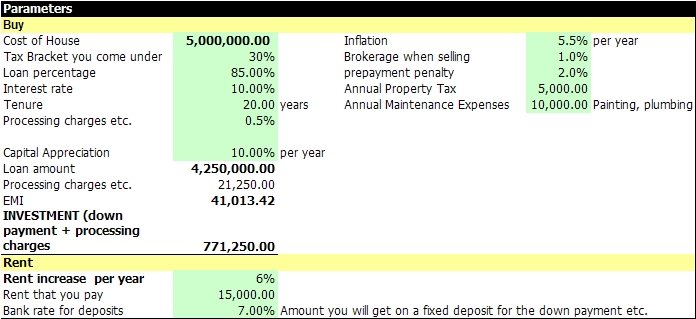
The return analysis on this, is in an excel sheet I have built, but here's the summary:

Key points to note:
* Cash flow wise, Renting is better for the first 8 years.
* After 8 years, buying is better, and after twenty years, the bought house is better by Rs. 1.4 crores!
* The equation is skewed to some extent because of the limits on the tax saving. The limit of Rs. 150,000 on the interest is too low - for the first 15 years, you pay more than 150,000 interest per year.
* Even the principal paid is more than 100,000 per year, so the tax saving there is limited too.
(Download the real estate calculator excel sheet)
If you're in for the long term you should buy, but remember this: If you think the prices will stabilize or come down in the next eight years, delay your decision to buy. After all, renting is far more cheaper and you will have much more money saved up in the longer term.
Also, be more aggressive in your investments to give you a better return, and therefore a better down payment.
Finally, remember that owning your house is important for sentimental and personal reasons too. The happiness you can derive from having an own house perhaps outweighs financial reasons.
The article has a link to get the excel sheet to calculate the difference between rented and self house w/ accrued gain/loss .
But I am attaching that excel sheet for your ready use.
Click here for Direct Link
The question one often asks when one gets to a comfortable state of personal affairs is: Should I rent a house or buy one?
All your friends are buying houses, or at least have "booked" them. There are good sentimental reasons to do so - owning a house ensures a tiny element of piece of mind - you can change things you don't like, like the drawers in your kitchen cabinet, or the paint on the walls, or add wooden flooring or a bathtub and such. But does it make financial sense to do this?
There are some advantages of each, but I shall take the Indian perspective. Here's where we are with Renting:
* Renting in India typically costs less than 3% of a house value. Meaning, if a house's market value is Rs. 50 lakhs, the rental will be around Rs. 15,000 per month.
* Tax breaks are available: Around 40% of your basic salary (or the rent, whichever is lower) is deductible from your taxable income.
But there are tax advantages for buying too. Here's where we are:
* Payments on Interest upto Rs. 150,000 per year is tax deductible.
* Principal repayments are tax free upto Rs. 100,000 per year. (Section 80C)
Let's see the comparison for a Rs. 50 Lakh house. I'm assuming that if you were to buy this house you will have a certain amount as "down payment" and pay a much higher EMI per month than the corresponding rent (Rs. 41,000 EMI, vs. Rs. 15,000 rent). If you rented, the extra money goes into the bank as a saving, and so does the down payment.
The return analysis on this, is in an excel sheet I have built, but here's the summary:

Key points to note:
* Cash flow wise, Renting is better for the first 8 years.
* After 8 years, buying is better, and after twenty years, the bought house is better by Rs. 1.4 crores!
* The equation is skewed to some extent because of the limits on the tax saving. The limit of Rs. 150,000 on the interest is too low - for the first 15 years, you pay more than 150,000 interest per year.
* Even the principal paid is more than 100,000 per year, so the tax saving there is limited too.
(Download the real estate calculator excel sheet)
If you're in for the long term you should buy, but remember this: If you think the prices will stabilize or come down in the next eight years, delay your decision to buy. After all, renting is far more cheaper and you will have much more money saved up in the longer term.
Also, be more aggressive in your investments to give you a better return, and therefore a better down payment.
Finally, remember that owning your house is important for sentimental and personal reasons too. The happiness you can derive from having an own house perhaps outweighs financial reasons.
Tuesday, September 1, 2009
Jeevan Tarang Policy from LIC
We will discuss about LIC's Jeevan Tarang Policy today and lets evaluate and answer the question "Is Jeevan Tarang worth consideration or Not" ?
Also see how can we beat this Policy by huge margin .
Jeevan Tarang Policy Highlights
* Jeevan Tarang is a Whole Life Plan from LIC , Whole life plan means that you are insured for whole life (max age 100) The plan offers three Accumulation periods – 10, 15 and 20 years. A proposer may choose any of them. This is the Tenure by when your Policy Matures.
* Whenever you die , you will get the Sum assured and then the Policy Expires . This policy will expire if you are at age 100 .
* If you Die before the Maturity , you will get the Sum Assured + All the Bonus Accumulated till date .
* The yearly Premium will depends on two things , your Tenure and your Age . It can range from 11% (Policy for 10 yrs) , 7-8% (Policy for 15 yrs) or 5-5.5% (policy for 20 yrs) .
For exact numbers see here. The percentages are with respect to your Sum Assured , 5.5% premium means 5.5% of your Sum assured . so Rs 10,00,000 of Sum assured means 55,000 of Premium each Year .
* Incase you survive till your Policy Tenure , then at the end of your Tenure , you will get Bonus accumulated (not the Sum assured) and an annuity of exact 5.5% each year after the Policy Matures . One will get 5.5% of the Sum Assured each year till his death or upto age 100 whichever is earlier .
* If you can not pay the Premiums and want to stop the policy (only after 3 yrs) , you have two choices , either make it a Paidup policy or take back the Surrender Value . This is explained in detail later , so move on .
* These are the main basic and approximate points of the Policy , for exact details see the policy page at LIC website .
Let us now see an example with different Scenario .This will help you understand it better.
Now let take Scenario's
Ajay's age is 30 and he takes Jeevan Tarang Policy for a tenure for 15 yrs with Sum Assured of Rs 10,00,000 (10 Lacs) . His Yearly Premiums will be 71.40 for every 1000 sum assured , which is 7.14% . Which comes to 71,400 per year .
If Ajay dies before 15 yrs
In this case he will get Sum Assured + Bonus Accumulated till date. The Bonus amount is not fixed and we can not tell how much it will be now , But on LIC webpage its mentioned in range of Rs 20-88 . Lets take a good figure of Rs 30 . In that case Per year it would be 30,000 more . So If he dies in 8th year , it would be 10 lacs (Sum Assured) + 2.4 lacs (bonus for 8 yrs) = 12.4 Lacs and the policy Expires .
If Ajay survives the Policy and does not die at all
In this case , Ajay will pay his premium upto 15 years and then in 15th year , he will get back the Bonus accumulated (not sum assured) , so may be it would be 4.5-5 lacs assuming Rs 30 as Bonus for every 1000 SA . Also he will get 55,000 per year(remember 5.5% of Sum Assured) as annuity till he dies or upto age 100 . He will also get Loyalty additions , this will again be a very small amount just like Bonus , but this is not assured at all .
If Ajay survives the Policy and Dies Later .
Its almost the same case as above , in this , Ajay will get Bonus at the end of 15 yrs and then He will start receiving 55,000 ever year . And suppose he dies before age 100 , he will receive the Sum Assured of Rs 10 lacs and that's it. The game is over and then LIC doesn't recognize him there after .
Ajay is not able to pay premiums because of some problem and wants to stop .
This is possible only after 3 yrs of taking the Policy , If he wants to stop it before 3 yrs , then sorry buddy , just forget your Money and go home cry . If its after 3 yrs , then He has two choices
* Make the Policy Paid up : In this case , you stop the Premium payments and you will get your Premiums and Bonus Accumulated will date at the end of the Maturity . You Sum assured will also reduce in Proportion to Premiums Paid, so if you stop the policy in 6th year , your Sum assured will reduce from 10 lacs to 4 lacs (40%) , as you have paid the premium only for 40% of the tenure (15 yrs) , that's 6 yrs .
* Take your Money Back : After 3 yrs of completion , the Policy acquires a Surrender value , generally its the Net Present Value of money in today's term what you are going to get at the end . See this post on Net Asset Value . So if you are going to get 5 lacs at the end of 15 yrs and today's worth of that money is 2 lacs , you will get 2 lacs today .
What is the Return of Jeevan Tarang Policy overall ?
Even if you receive all the annuity upto your age of 100 , the CAGR return for this policy using IRR Analysis comes to mere 4.72% . I have taken the above example and assumed 5 lacs of Bonus and no loyalty additions , even if we consider 7-8 lacs of Bonus and Some loyalty additions, the CAGR return does not cross 6% CAGR .
Why this Policy excites people and general people get fooled ?
These kind of Endowment policies make sure that you concentrate too much on numbers and it traps your mindset in the present moment , One who is able to foresee beyond "now" can understand the real value of these Policies .
We concentrate on numbers, If we get something for a long time and we pay for less time , it appeals to us , and hence this policy takes care of that very beautifully , You pay for 10 , 15 or 20 yrs and you get back till you are Age 100 , Sounds great !! .
Psychologically our mind is programmed by nature to think about the best case for our self , but how many of us will survive upto 100 yrs to get annuity back, The average person thinks emotionally , Insurance Companies work on Data , Statistics , Probability Theory and Complex calculations , which tell them that average person will die at 60-70 , and only 1-2 will survive till 100 years of their age .
Most of the people see Numbers and Present , The policy will demonstrate how much You will get at the end of the Maturity but it never tells you how much will it be worth then and how much will it help you in your Financial goals . We never think that Rs 100 today can buy much more than Rs 100 after 15 or 30 yrs . We know this somewhere inside us , but out mind just doesn't feel every time the same way , that's the reason you need to calculate things by hand , on paper or computer and do some small analysis like I did on this article . Then you get the clarity
Trust and Blind Faith , We trust companies because they have been in existence from long time and our parents were made to believe that these are the best friends in our life , they will protect our Future . Love and "Taking Endowment Policies" in India has similarity . I grew up hearing Love is Blind and experienced it too , and I feel that its same with Taking Endowment Polices . People just take it blindly , some new Policy comes up and bang !! , it has to be great , no matter what , because it comes from the GOD's own company !! . No one will concentrate on 4 important features of his portfolio and how that policy fits in.
What are the Limitations of the Policy
* Why age 100 ? How many people are going to live upto age 100 , why putting that number at 100 , why not increase it to 500 , even though life expectancy is just 60-70 . Not more than 1-2 in 100 live upto 100 .
* In case of Ajay , if his monthly expenses is 30,000 (considering married ,even though I doubt he will ever get any one) , after the accumulation period of 15 yrs , he will start receiving yearly pension of 55,000 per year , read it again , 55,000 per year , but now after 15 yrs , even with 6% of inflation his monthly expenses has gone upto 72,000 . And his policy pays him 55,000 which cannot even take care of his 1 month of expenses . Now i can see him pulling all his hairs .
* If he is dead at age 70 , His family would get back the Sum assured of 10 lacs and at that time , it can only pay for his family's 3-4 months of expenses and his Funeral cost , that's it .. Aha .. atleast something , so one this is confirmed , There will be no financial burden , pun intended .
Can we do better ?
This is the question which we should always ask in every situation of our life , not just Financial planning . Lets take care of Ajay's situation and plan him something better than Jeevan Tarang .
With Rs 71,600 per year to pay for 15 yrs , lets see what can we do .
First thing First , Lets cover his Family first from the Mishappenings of life an secure his dependents , Lets take a Term Insurance of 50 lacs for maximum tenure of 30 yrs , Premium would be close to 13k or 14k approx , lets assume 14k . So out of 71,600 , 14k is gone and we are left with 57,600 .
Now lets put 21,600 each year in PPF for 15 yrs . We are now left with 36,000 to invest , we will start Rs 3,000 SIP per month (Rs 1000 each in 3 different Equity funds) for 15 yrs .
PPF will accumulate to 6.3 lacs in 15 yrs and Mutual funds will accumulate to 15 lacs in 15 yrs assuming a pessimistic return of just 12% (Historical return has been more than 17% and last 5 yrs return are more than 25%) . Lets assume just 12% and not 18-20% even though its possible because our aim is to do better than Jeevan Tarang and achieve our goals and not compete with some one . So total amount will be around 21.3 lacs at the end of 15 yrs . Now lets visit and see our Scenario's again and hows does it compare now .
If Ajay dies before 15 yrs : Gets 50 lacs from Term Insurance and also the money from PPF and mutual funds , which will be more than 50 lacs :) . We beat Jeevan Tarang by huge margin in this case .
If Ajay survives and Does not Die at all : In this case he already has 21.3 lacs accumulated and now he can use this amount to buy an Annuity which will pay him more than 1.6 lacs Per year , much more than what he was getting in LIC policy . As a toppings , he also has a 50 lac cover for another 15 years . We can generate 3 times more annuity than Jeevan Astha here , again beat by huge margin .
If Ajay survives the Policy and Dies Later : In this case if he dies in next 15 yrs , his family would get 50 lacs from Insurance (10 lacs in LIC - Jeevan Tarang) , apart from this he will have his 21.3 lacs growing every year . If he dies after 15 more year , There will be no Insurance money , but his money would have grown a lot by now .. If he dies after 15 yrs (total 30 yrs from starting) , his money would have grown to 1.17 crores assuming 12% return per year (no annuity every year) . and if he dies after 25 years (total 40 yrs from starting , means at age 70) , his money would have grown to 6 crores . Now incase you don't want to faint , don't ask me how much would have he had if he lived till age 100 and left his money to grow , Its 13 crores :) . I have not assumed any annual annuity here , we can do that but the result would remain almost same . We beat Jeevan Tarang by hugest margin in this case .
Ajay is not able to pay premiums because of some problem and wants to stop .
His money will still be in PPF and Mutual funds and keep growing , there is no liquidity issue with Mutual funds , he can withdraw from mutual funds anytime ,even from PPF he can withdraw partially . If he has limited money , he can atleast pay his Insurance premiums and still get covered for 50 lacs , no big deal there . In every aspect it beats Jeevan Tarang
Note : For doing better than Jeevan Tarang we have invested in Mutual funds which are risky instruments , but anyways we are not in great position with Jeevan Tarang . so taking risk is worth it . If one is too concerned about risk , then even plain PPF will be better .
Conclusion : Think Logical , Think mathematical , Think smartly and atlast THINK !! .
Note : The figures have not considered the rebate provided by LIC , and hence the actual figures can deviate a bit from the actual numbers used here , but it wont be significant and the review still holds . ahh .. tired now !!
Also see how can we beat this Policy by huge margin .
Jeevan Tarang Policy Highlights
* Jeevan Tarang is a Whole Life Plan from LIC , Whole life plan means that you are insured for whole life (max age 100) The plan offers three Accumulation periods – 10, 15 and 20 years. A proposer may choose any of them. This is the Tenure by when your Policy Matures.
* Whenever you die , you will get the Sum assured and then the Policy Expires . This policy will expire if you are at age 100 .
* If you Die before the Maturity , you will get the Sum Assured + All the Bonus Accumulated till date .
* The yearly Premium will depends on two things , your Tenure and your Age . It can range from 11% (Policy for 10 yrs) , 7-8% (Policy for 15 yrs) or 5-5.5% (policy for 20 yrs) .
For exact numbers see here. The percentages are with respect to your Sum Assured , 5.5% premium means 5.5% of your Sum assured . so Rs 10,00,000 of Sum assured means 55,000 of Premium each Year .
* Incase you survive till your Policy Tenure , then at the end of your Tenure , you will get Bonus accumulated (not the Sum assured) and an annuity of exact 5.5% each year after the Policy Matures . One will get 5.5% of the Sum Assured each year till his death or upto age 100 whichever is earlier .
* If you can not pay the Premiums and want to stop the policy (only after 3 yrs) , you have two choices , either make it a Paidup policy or take back the Surrender Value . This is explained in detail later , so move on .
* These are the main basic and approximate points of the Policy , for exact details see the policy page at LIC website .
Let us now see an example with different Scenario .This will help you understand it better.
Now let take Scenario's
Ajay's age is 30 and he takes Jeevan Tarang Policy for a tenure for 15 yrs with Sum Assured of Rs 10,00,000 (10 Lacs) . His Yearly Premiums will be 71.40 for every 1000 sum assured , which is 7.14% . Which comes to 71,400 per year .
If Ajay dies before 15 yrs
In this case he will get Sum Assured + Bonus Accumulated till date. The Bonus amount is not fixed and we can not tell how much it will be now , But on LIC webpage its mentioned in range of Rs 20-88 . Lets take a good figure of Rs 30 . In that case Per year it would be 30,000 more . So If he dies in 8th year , it would be 10 lacs (Sum Assured) + 2.4 lacs (bonus for 8 yrs) = 12.4 Lacs and the policy Expires .
If Ajay survives the Policy and does not die at all
In this case , Ajay will pay his premium upto 15 years and then in 15th year , he will get back the Bonus accumulated (not sum assured) , so may be it would be 4.5-5 lacs assuming Rs 30 as Bonus for every 1000 SA . Also he will get 55,000 per year(remember 5.5% of Sum Assured) as annuity till he dies or upto age 100 . He will also get Loyalty additions , this will again be a very small amount just like Bonus , but this is not assured at all .
If Ajay survives the Policy and Dies Later .
Its almost the same case as above , in this , Ajay will get Bonus at the end of 15 yrs and then He will start receiving 55,000 ever year . And suppose he dies before age 100 , he will receive the Sum Assured of Rs 10 lacs and that's it. The game is over and then LIC doesn't recognize him there after .
Ajay is not able to pay premiums because of some problem and wants to stop .
This is possible only after 3 yrs of taking the Policy , If he wants to stop it before 3 yrs , then sorry buddy , just forget your Money and go home cry . If its after 3 yrs , then He has two choices
* Make the Policy Paid up : In this case , you stop the Premium payments and you will get your Premiums and Bonus Accumulated will date at the end of the Maturity . You Sum assured will also reduce in Proportion to Premiums Paid, so if you stop the policy in 6th year , your Sum assured will reduce from 10 lacs to 4 lacs (40%) , as you have paid the premium only for 40% of the tenure (15 yrs) , that's 6 yrs .
* Take your Money Back : After 3 yrs of completion , the Policy acquires a Surrender value , generally its the Net Present Value of money in today's term what you are going to get at the end . See this post on Net Asset Value . So if you are going to get 5 lacs at the end of 15 yrs and today's worth of that money is 2 lacs , you will get 2 lacs today .
What is the Return of Jeevan Tarang Policy overall ?
Even if you receive all the annuity upto your age of 100 , the CAGR return for this policy using IRR Analysis comes to mere 4.72% . I have taken the above example and assumed 5 lacs of Bonus and no loyalty additions , even if we consider 7-8 lacs of Bonus and Some loyalty additions, the CAGR return does not cross 6% CAGR .
Why this Policy excites people and general people get fooled ?
These kind of Endowment policies make sure that you concentrate too much on numbers and it traps your mindset in the present moment , One who is able to foresee beyond "now" can understand the real value of these Policies .
We concentrate on numbers, If we get something for a long time and we pay for less time , it appeals to us , and hence this policy takes care of that very beautifully , You pay for 10 , 15 or 20 yrs and you get back till you are Age 100 , Sounds great !! .
Psychologically our mind is programmed by nature to think about the best case for our self , but how many of us will survive upto 100 yrs to get annuity back, The average person thinks emotionally , Insurance Companies work on Data , Statistics , Probability Theory and Complex calculations , which tell them that average person will die at 60-70 , and only 1-2 will survive till 100 years of their age .
Most of the people see Numbers and Present , The policy will demonstrate how much You will get at the end of the Maturity but it never tells you how much will it be worth then and how much will it help you in your Financial goals . We never think that Rs 100 today can buy much more than Rs 100 after 15 or 30 yrs . We know this somewhere inside us , but out mind just doesn't feel every time the same way , that's the reason you need to calculate things by hand , on paper or computer and do some small analysis like I did on this article . Then you get the clarity
Trust and Blind Faith , We trust companies because they have been in existence from long time and our parents were made to believe that these are the best friends in our life , they will protect our Future . Love and "Taking Endowment Policies" in India has similarity . I grew up hearing Love is Blind and experienced it too , and I feel that its same with Taking Endowment Polices . People just take it blindly , some new Policy comes up and bang !! , it has to be great , no matter what , because it comes from the GOD's own company !! . No one will concentrate on 4 important features of his portfolio and how that policy fits in.
What are the Limitations of the Policy
* Why age 100 ? How many people are going to live upto age 100 , why putting that number at 100 , why not increase it to 500 , even though life expectancy is just 60-70 . Not more than 1-2 in 100 live upto 100 .
* In case of Ajay , if his monthly expenses is 30,000 (considering married ,even though I doubt he will ever get any one) , after the accumulation period of 15 yrs , he will start receiving yearly pension of 55,000 per year , read it again , 55,000 per year , but now after 15 yrs , even with 6% of inflation his monthly expenses has gone upto 72,000 . And his policy pays him 55,000 which cannot even take care of his 1 month of expenses . Now i can see him pulling all his hairs .
* If he is dead at age 70 , His family would get back the Sum assured of 10 lacs and at that time , it can only pay for his family's 3-4 months of expenses and his Funeral cost , that's it .. Aha .. atleast something , so one this is confirmed , There will be no financial burden , pun intended .
Can we do better ?
This is the question which we should always ask in every situation of our life , not just Financial planning . Lets take care of Ajay's situation and plan him something better than Jeevan Tarang .
With Rs 71,600 per year to pay for 15 yrs , lets see what can we do .
First thing First , Lets cover his Family first from the Mishappenings of life an secure his dependents , Lets take a Term Insurance of 50 lacs for maximum tenure of 30 yrs , Premium would be close to 13k or 14k approx , lets assume 14k . So out of 71,600 , 14k is gone and we are left with 57,600 .
Now lets put 21,600 each year in PPF for 15 yrs . We are now left with 36,000 to invest , we will start Rs 3,000 SIP per month (Rs 1000 each in 3 different Equity funds) for 15 yrs .
PPF will accumulate to 6.3 lacs in 15 yrs and Mutual funds will accumulate to 15 lacs in 15 yrs assuming a pessimistic return of just 12% (Historical return has been more than 17% and last 5 yrs return are more than 25%) . Lets assume just 12% and not 18-20% even though its possible because our aim is to do better than Jeevan Tarang and achieve our goals and not compete with some one . So total amount will be around 21.3 lacs at the end of 15 yrs . Now lets visit and see our Scenario's again and hows does it compare now .
If Ajay dies before 15 yrs : Gets 50 lacs from Term Insurance and also the money from PPF and mutual funds , which will be more than 50 lacs :) . We beat Jeevan Tarang by huge margin in this case .
If Ajay survives and Does not Die at all : In this case he already has 21.3 lacs accumulated and now he can use this amount to buy an Annuity which will pay him more than 1.6 lacs Per year , much more than what he was getting in LIC policy . As a toppings , he also has a 50 lac cover for another 15 years . We can generate 3 times more annuity than Jeevan Astha here , again beat by huge margin .
If Ajay survives the Policy and Dies Later : In this case if he dies in next 15 yrs , his family would get 50 lacs from Insurance (10 lacs in LIC - Jeevan Tarang) , apart from this he will have his 21.3 lacs growing every year . If he dies after 15 more year , There will be no Insurance money , but his money would have grown a lot by now .. If he dies after 15 yrs (total 30 yrs from starting) , his money would have grown to 1.17 crores assuming 12% return per year (no annuity every year) . and if he dies after 25 years (total 40 yrs from starting , means at age 70) , his money would have grown to 6 crores . Now incase you don't want to faint , don't ask me how much would have he had if he lived till age 100 and left his money to grow , Its 13 crores :) . I have not assumed any annual annuity here , we can do that but the result would remain almost same . We beat Jeevan Tarang by hugest margin in this case .
Ajay is not able to pay premiums because of some problem and wants to stop .
His money will still be in PPF and Mutual funds and keep growing , there is no liquidity issue with Mutual funds , he can withdraw from mutual funds anytime ,even from PPF he can withdraw partially . If he has limited money , he can atleast pay his Insurance premiums and still get covered for 50 lacs , no big deal there . In every aspect it beats Jeevan Tarang
Note : For doing better than Jeevan Tarang we have invested in Mutual funds which are risky instruments , but anyways we are not in great position with Jeevan Tarang . so taking risk is worth it . If one is too concerned about risk , then even plain PPF will be better .
Conclusion : Think Logical , Think mathematical , Think smartly and atlast THINK !! .
Note : The figures have not considered the rebate provided by LIC , and hence the actual figures can deviate a bit from the actual numbers used here , but it wont be significant and the review still holds . ahh .. tired now !!
Sunday, August 30, 2009
Should you invest in Monthly Income Plans?
It's common for diversified equity funds to emerge as a top-of-the-mind investment when stock markets are booming. In such a scenario, hybrid funds like Balanced Funds and Monthly Income Plans (MIPs) are relegated to the sidelines. Investors can miss out on a very critical component in their portfolio by shutting out hybrid funds completely. Hybrid funds (powered by their flexibility to invest across asset classes) can add immense value to the investor's portfolio (especially during the down turn). While the role of balanced funds in the investor's portfolio has been well-documented, it is time for investors to sit up and recognise the value MIPs can add to their portfolio.
MIPs invest predominantly in debt instruments with a small portion of assets allocated to equities. The equity component provides MIPs with just the edge it needs to outperform conventional debt funds. The equity component usually varies between 5%-30% of assets. So under what circumstances would MIPs add value to an investor's portfolio? The graph below answers this question.
As is evident from the graph, during the crash in the stock markets last year, MIPs have fallen less as compared to the BSE Sensex indices. And this is where it adds value to an investor's portfolio. When the stock markets rally, they will lag conventional equity funds, but when the markets move down, they will limit the fall in an investor's portfolio.
Hence MIPs become important from an asset allocation perspective. Although, you can reach the desired asset allocation by allocating the assets in equity and debt; MIPs offer a convenient way of achieving the same.
Time to cash out?
Though the stock markets continue to be volatile, they have recovered from the lows touched in March this year. The markets have posted a growth of around 93% (as on August 26, 2009) since March 8, 2009. Expectedly, many investors who have lost a huge chunk of their invested corpus in the stock market crash last year are now eager to recover whatever they can. Now the question is - is it the right time for you to cash out? While you would promptly say YES, at Personal FN we have a contrarian view on this.
Sensex: Rise of the fallen
Broadly, there could be two reasons for making investments. First, and the most ideal reason, is to invest for the purpose of meeting one or more of your future goals/objectives. Second, and unfortunately the most commonly practiced, is to make "quick bucks" by participating in market movements. The latter option amounts to timing the markets, something that many investors try to do, but rarely succeed.
In our view, redeeming investments should not be a function of market movements, but rather a result of the following:
1. Redeem if you are sure that the fund in question has failed to meet its purpose in your financial plan. The reasons behind this could include poor performance or change in investment mandate of the fund, which makes it a misfit in your portfolio.
2. Redeem if you have to rebalance your asset allocation. Also,before you cash out, make sure that you have decided where to reinvest the redemtpion proceeds.
3. Redeem when you have achieved your investment objective.
Financing Avenues available for Studying Abroad
If you aspire to study abroad and are looking to fund your education, then this piece is for you. Financial aid, education loans and bursaries are the broad categories of finances available to students aspiring to study overseas.
Financial aid primarily comprises of scholarships offered by governments, universities, corporates and charitable trusts. Generally, exceptionally intelligent students qualify for such scholarships. Students who wish to apply for university scholarships have the opportunity to do so at the time of applying for the course. For example, HSBC offers two scholarships for students with guaranteed admission in Oxford, Cambridge and London Universities. Applications for these are accepted between April and June, every year.
Bursaries are endowments given to students based on financial need, and are used to supplement the student's primary source of funding. While this will be a starting point, it would bring down the requirement for funds to some extent.
Education loans are granted by banks and many private institutions (like the JN Tata Endowment for Higher Education of Indians). Education loans offered by banks normally have interest rates in the range of 11%-13% p.a., along with strict norms and collateral requirements for overseas degrees. The repayment period is normally between 5-7 years, and starts after completion of the education or 6 months after securing a job, whichever is earlier.
If a student is not able to get a scholarship and is short on funds, then he has no other option than to opt for an education loan. Although financing avenues have increased nowadays, it is imperative that students take the initiative to research the various funding options available to them and ensure that it meets their requirements.
Where to invest: Liquid Funds...Liquid Plus Funds...or Bank FDs
Liquid funds with no entry and exit loads and practically no credit risk, have not only been popular with banks and companies to park their short term money, but have also emerged as stiff competition to the savings bank a/c. For the past few years, post-tax returns from liquid funds have been in the range of 5%-6% p.a. making them a hit among individual investors especially the high net worth investors (HNIs). However, liquid funds are fast losing their edge over the savings bank a/c with average returns dropping to 3.5% p.a. This is mainly on account of the decline in short-term interest rates and the SEBI guideline restricting these funds from investing in any security having a residual maturity of more than 91 days. The average maturity period of most of these funds ranges from 50 to 60 days.
Is there an alternative to liquid funds? Yes, investors can consider investing their money in ultra short bond funds (erstwhile liquid plus funds). These funds can invest in securities with higher maturities and hence are able to generate returns which are 50-80 basis points higher than liquid funds. However, these extra returns come with slightly higher interest rate risk and credit risk. Most of these funds also have a lock-in period of at least 7 days. The average maturity period of these funds ranges from 140-150 days.
There is yet another option for individual investors. Of late banks have been offering a facility to transfer the money sitting idle in savings bank a/c to fixed deposits. The rate of fixed deposit is however, slightly less than the rate of a conventional FD for similar maturity.
The beauty of this facility is that the money lying in the fixed deposits is not subject to any kind of lock-in i.e. the investor can withdraw the money as and when required either through the ATM or by issuing a cheque without any penalty for premature withdrawal. Moreover, if the interest rates move up, money can be moved from lower interest rate FDs to higher interest rate FDs without any penalty. To top it up, the amount can be transferred either online or through simple instructions on the phone using the ATM/debit card number and the PIN. We urge investors to check with their bank for any such facility and if it does exist go for it NOW. After all, opportunity only knocks once!
MIPs invest predominantly in debt instruments with a small portion of assets allocated to equities. The equity component provides MIPs with just the edge it needs to outperform conventional debt funds. The equity component usually varies between 5%-30% of assets. So under what circumstances would MIPs add value to an investor's portfolio? The graph below answers this question.
As is evident from the graph, during the crash in the stock markets last year, MIPs have fallen less as compared to the BSE Sensex indices. And this is where it adds value to an investor's portfolio. When the stock markets rally, they will lag conventional equity funds, but when the markets move down, they will limit the fall in an investor's portfolio.
Hence MIPs become important from an asset allocation perspective. Although, you can reach the desired asset allocation by allocating the assets in equity and debt; MIPs offer a convenient way of achieving the same.
Time to cash out?
Though the stock markets continue to be volatile, they have recovered from the lows touched in March this year. The markets have posted a growth of around 93% (as on August 26, 2009) since March 8, 2009. Expectedly, many investors who have lost a huge chunk of their invested corpus in the stock market crash last year are now eager to recover whatever they can. Now the question is - is it the right time for you to cash out? While you would promptly say YES, at Personal FN we have a contrarian view on this.
Sensex: Rise of the fallen
Broadly, there could be two reasons for making investments. First, and the most ideal reason, is to invest for the purpose of meeting one or more of your future goals/objectives. Second, and unfortunately the most commonly practiced, is to make "quick bucks" by participating in market movements. The latter option amounts to timing the markets, something that many investors try to do, but rarely succeed.
In our view, redeeming investments should not be a function of market movements, but rather a result of the following:
1. Redeem if you are sure that the fund in question has failed to meet its purpose in your financial plan. The reasons behind this could include poor performance or change in investment mandate of the fund, which makes it a misfit in your portfolio.
2. Redeem if you have to rebalance your asset allocation. Also,before you cash out, make sure that you have decided where to reinvest the redemtpion proceeds.
3. Redeem when you have achieved your investment objective.
Financing Avenues available for Studying Abroad
If you aspire to study abroad and are looking to fund your education, then this piece is for you. Financial aid, education loans and bursaries are the broad categories of finances available to students aspiring to study overseas.
Financial aid primarily comprises of scholarships offered by governments, universities, corporates and charitable trusts. Generally, exceptionally intelligent students qualify for such scholarships. Students who wish to apply for university scholarships have the opportunity to do so at the time of applying for the course. For example, HSBC offers two scholarships for students with guaranteed admission in Oxford, Cambridge and London Universities. Applications for these are accepted between April and June, every year.
Bursaries are endowments given to students based on financial need, and are used to supplement the student's primary source of funding. While this will be a starting point, it would bring down the requirement for funds to some extent.
Education loans are granted by banks and many private institutions (like the JN Tata Endowment for Higher Education of Indians). Education loans offered by banks normally have interest rates in the range of 11%-13% p.a., along with strict norms and collateral requirements for overseas degrees. The repayment period is normally between 5-7 years, and starts after completion of the education or 6 months after securing a job, whichever is earlier.
If a student is not able to get a scholarship and is short on funds, then he has no other option than to opt for an education loan. Although financing avenues have increased nowadays, it is imperative that students take the initiative to research the various funding options available to them and ensure that it meets their requirements.
Where to invest: Liquid Funds...Liquid Plus Funds...or Bank FDs
Liquid funds with no entry and exit loads and practically no credit risk, have not only been popular with banks and companies to park their short term money, but have also emerged as stiff competition to the savings bank a/c. For the past few years, post-tax returns from liquid funds have been in the range of 5%-6% p.a. making them a hit among individual investors especially the high net worth investors (HNIs). However, liquid funds are fast losing their edge over the savings bank a/c with average returns dropping to 3.5% p.a. This is mainly on account of the decline in short-term interest rates and the SEBI guideline restricting these funds from investing in any security having a residual maturity of more than 91 days. The average maturity period of most of these funds ranges from 50 to 60 days.
Is there an alternative to liquid funds? Yes, investors can consider investing their money in ultra short bond funds (erstwhile liquid plus funds). These funds can invest in securities with higher maturities and hence are able to generate returns which are 50-80 basis points higher than liquid funds. However, these extra returns come with slightly higher interest rate risk and credit risk. Most of these funds also have a lock-in period of at least 7 days. The average maturity period of these funds ranges from 140-150 days.
There is yet another option for individual investors. Of late banks have been offering a facility to transfer the money sitting idle in savings bank a/c to fixed deposits. The rate of fixed deposit is however, slightly less than the rate of a conventional FD for similar maturity.
The beauty of this facility is that the money lying in the fixed deposits is not subject to any kind of lock-in i.e. the investor can withdraw the money as and when required either through the ATM or by issuing a cheque without any penalty for premature withdrawal. Moreover, if the interest rates move up, money can be moved from lower interest rate FDs to higher interest rate FDs without any penalty. To top it up, the amount can be transferred either online or through simple instructions on the phone using the ATM/debit card number and the PIN. We urge investors to check with their bank for any such facility and if it does exist go for it NOW. After all, opportunity only knocks once!
Friday, July 17, 2009
LIC ATM Plan Analysis
LIC Jeevan Saral Plan is also called as ATM plan
==================================
Product Summary
-------------------
This is an Endowment Assurance plan where the proposer has simply to choose the amount and mode of premium payment. The plan provides financial protection against death throughout the term of the plan. The death benefit is directly related to the premiums paid. The Maturity Sum Assured depends on the age at entry of the life to be assured and is payable on survival to the end of the policy term. It also offers the flexibility of term and a lot of liquidity.
Benefit Illustration
---------------------
http://www.licindia.com/special_plan_001_illustration.htm
Amount invested per annum = Rs 4704
Term = 25 years
Normal Circumstances :- Investor survives full term
-----------------------------------------------------
Sum Assured (Gauranteed) = 117600
Maturity Bonus (Variable @ 10%) = 211000
Total Amount (Maximum as per LIC) = 346296
Un-usual Circumstances :- Investor dies before full term
---------------------------------------------------------
Death Benefit:
250 times the monthly premium together with loyalty additions, if any, and return of premiums excluding first year premiums and extra/rider premium, if any, is payable in lump sum on death of the life assured during the term of the policy.
Year Sum_Assured Maturity_Bonus Total
----------------------------------------------------
1 100000 0 100000
2 104800 0 104800
3 109600 0 109600
4 114400 0 114400
5 119200 0 119200
6 124000 0 124000
7 128800 0 128800
8 133600 0 133600
9 138400 0 138400
10 143200 18000 161200
15 167200 41000 208200
20 191200 100000 291200
25 215200 211000 426200
DISCLAIMER
==========
TO BE FAIR WITH LIC I AM TAKING THE MAXIMUM RETURNS THAT LIC IS DEPICTING ON THEIR SITE.
LIC CALCULATED THE RETURN @ 10%.
BUT IN THE 25-30 YEARS OF HISTORY OF LIC, THEY HAVE NEVER GIVEN MORE THAN 6% RETURNS.
BUT STILL TO BE FAIR, I HAVE BASED MY CALCULATION ASSUMING THE MAXIMUM RETURNS SHOWN ON THEIR OFFICIAL SITE.
Normal Case - Survival Benifit
-------------------------------
If you go through the link provided above (LIC site) you will see that in normal case (Survival),
For first nine years, You have paid the amount Rs 42,336 /-
And in return LIC is giving you Rs 37,892 /-. Less than what you have actually paid.
The policy term is of minimum 10 Years.
So in 10 years you have paid to LIC RS 47,040 /-
In return at the end of 10th year LIC will payback :-
43,360 (Guaranteed) + 18,000 (Bonus) = Rs 61,360 /-
What is the Rate Of Interest that you are getting ? [You need to apply ANNUITY Formulla]
Ii comes to 4.8 % ONLY (For survival person) (Shame on LIC)
If you continue for whole 25 years term
You would have paid Rs 1,17,600 /-
In turn LIC gave you back Rs 3,46,296 /-
What is the Rate Of Interest now that you are getting ? [You need to apply ANNUITY Formulla]
It comes to 7.55 % ONLY (For survival person)
Only in case of Un-Usual circumstances the benefit your "Nominee" will get is if you "DIE" before the first 10 years of the policy term. The benefit amount is less that 1.5 Lacs.
Is this really sufficient after 10 years?
As you know, I have always/repeatedly/insistly told not to go for ENDOWMENT POLICY.
Again I am repeating same thing, do not go for any endowment policies.
--------------------------------------------------------------------------------
Keep INSURANCE and INVESTMENT different. Do not try to merge both things.
Investment
========
Go for PPF @ 8% returns. What will be the returns after 10 years ?
You paid # 47040 /- You will get # Rs 73,596 /-
If you continue this for 25 years
You paid # 117600 /- You will get # Rs 3,71,401 /-
Insurance
=======
Go for Term Insurance Policy
LIC Anmol Jeevan - I
Policy Term # 25 years
Current Age # 30 years
Sum Assured 5,00,000 [5 Lacs and not 1 Lacs]
Single premium comes to Rs 23,245 /-
Yearly Premium comes to Rs 1,911 /-
--------------------------------------------------------------------------------
After 25 years in case of LIC ATM plan you are getting Rs 3,46,296 /-
After 25 years in case of PPF you are getting Rs 3,71,401 /-
Gain in case of PPF # Rs 25,105 /-
This is more than the difference that you will be paying as one time to get the Term Life cover of 5 Lacs.
--------------------------------------------------------------------------------
If you could not afford single payment then next option will be :-
Go for annual premium of Rs 1911 /-
So you will be left with ( 4704 - 1911 ) = Rs 2793 /-
Invest this Rs 2793 in some tax free Mutual Fund.
Last 5 years return for top 10 Mutual funds are as below:-
---------------------------------
Mutual Fund Percent
---------------------------------
SBI Magnum taxgain 37.22
Sundaram BNP paribas 32.57
HDFC Taxsaver 29.43
Canara Robeco tax 28.69
Tauras Tax Shield 27.73
ICICI Prudential tax 25.79
Sahara Tax gain 25.78
Franklin Taxshield 23.40
HDFC LT Adv 22.64
Franklin Index Tax 21.95
---------------------------------
If we think of conservatively and think to get the decent return of 12% ONLY
So the amount Rs 2793 /- invested for 25 years at 12% returns will fetch Rs 4,17,089 /-
--------------------------------------------------------------------------------
So what you should do (Instead of LIC ATM Plan)
Take Term Insurance "LIC Anmol Jeevan - I", Term # 25 years
Sum Assured 5,00,000 [5 Lacs and not 1 Lacs].
You will have to pay Rs 1911 /-
Remaining amount Rs 2793 /-
You can invest in any one of the above top 10 TAX FREE Mutual Funds
Mutual Fund Returns after 25 Years Rs 4,17,089 /- (Insurance of 5 Lacs)
PPF Returns after 25 Years Rs 3,71,401 /- (No Insurance cover)
LIC ATM Plan Returns after 25 Years Rs 3,46,296 /- (Insurance of 1 Lacs) (Survival)
--------------------------------------------------------------------------------
LIC ATM Plan :- In case of Death :- Benifits to nominee are as below :-
Returns after 10 Years Rs 1,61,200 (You have paid Rs 47,040)
Returns after 20 Years Rs 2,91,200 (You have paid Rs 94,080)
Returns after 25 Years Rs 4,26,200 (You have paid Rs 1,17,600)
Term Insurance + Mutual Funds @ 12 % returns in case of Death :-
Benifits to nominee are as below :-
Returns after 10 Years Rs 5,00,000 + Rs 54,895 (You have paid Rs 47,040)
Returns after 20 Years Rs 5,00,000 + Rs 2,25,391 (You have paid Rs 94,080)
Returns after 25 Years Rs 5,00,000 + Rs 4,17,089 (You have paid Rs 1,17,600)
Term Insurance + Mutual Funds @ 10 % returns in case of Death :-
Benifits to nominee are as below :-
Returns after 10 Years Rs 5,00,000 + Rs 48,965 (You have paid Rs 47,040)
Returns after 20 Years Rs 5,00,000 + Rs 1,75,966 (You have paid Rs 94,080)
Returns after 25 Years Rs 5,00,000 + Rs 3,02,151 (You have paid Rs 1,17,600)
Conclusion :- The LIC ATM policy is not WORTH !!!
Thursday, July 16, 2009
Reason to Pay OFF Your Bank Loan ASAP
How Bank Loan EMI is calculated
In this post we will learn how do we calculate monthly EMI for home Loan (or any Loan) and how increasing tenure does not help much after a certain point.
In Housing Finance, Equated Monthly Installment(EMI) refers to the monthly payment towards interest and principal made by a borrower to a lender. EMI is calculated using a formula that considers.
- Loan Amount
- Interest Rate
- Loan Period
Formula to get EMI = ( L x i ) X (( 1 + i ) ^ N) / ([(1+i)^N] - 1)
Where,
L = Loan amount
i = Interest Rate (rate per annum divided by 12)
^ = to the power of
N = loan period in months
Assuming a loan of Rs 1 Lakh at 11 percent per annum, repayable in 15 years,
the EMI calculation using the formula will be :
EMI = (100000 x .00916) x ((1+.00916)^180 ) / ([(1+.00916)^180] - 1)
====> 916 X (5.161846 / 4.161846)
EMI = Rs 1,136
Note : i = 11 percent / 12 = .11/12 = .00916
EMI calculator : http://contentlinks.asiancerc.
Do the calculation yourself to get better understanding.
Q. How much benefit we get by increasing the Tenure of the Loan. Considering a Loan of Rs 30 Lacs at 12% interest rate.
Ans: The difference in EMI value is not very significant compared to the change in tenure and at one stage its almost of no gain to increase the tenure. To prove this argument i would like to present an example.
I am listing down the EMI value for different tenures from 10 years to 100 years.
Check the difference in EMI when tenure is increased by 5 years.
Loan Amount 30 Lacs taken on 12% interest rate.
==============
Tenure EMI
==============
10 43041
15 36005
20 33032
25 31596
30 30858
35 30466
40 30254
45 30139
50 30076
55 30042
60 30023
65 30012
70 30007
75 30003
80 30002
85 30001
90 30000
95 30000
100 30000
==============
What it tells us is that it's almost useless to extend the tenure after some time.
So better pay off your loans as soon as possible.
Few more EMI Calculator
http://www.icicibank.com/Pfsuser/loans/homeloans/emicalculator.htm
What it tells us is that it's almost useless to extend the tenure after some time.
So better pay off your loans as soon as possible.
Few more EMI Calculator
http://www.icicibank.com/
http://www.ucobank.com/EMI_calculator.htm
Wednesday, July 1, 2009
Diversified Protfolio
What is Portfolio ?
Your investments all together is your portfolio , as simple as that .
So , if i have
10,000 in shares
20,000 in real estate
30,000 in Fixed Deposits
1,000 cash
that's my portfolio
What is an Asset Class ?
An Asset class is something where we can invest and build assets. If i buy a Home or land, i build an asset in real estate category, if i buy anything in shares or mutual funds (equity), i create assets in Equity asset class. They are just categories.
Following are some asset classes:
Why Diversification ?
When you diversify you investments over different asset class, not only your money gets diversified, but also risk, so if some particular asset class is not performing well, it will affect only that part of your portfolio and not whole of it.
Obviously it also effects the returns, you returns are collection of returns from all the asset class, so even if some asset class did not perform over a period, it doesn't affect you hardly.
Lets see some examples :
1. Anyone who was heavily invested in "Debt" around 2003-2004 didn't get high returns
from the zooming stock markets (equity) for 4-5 yrs
2. Anyone who was heavily invested in Equity around start of 2008, saw his investments
go down by 40-60%
3. Anyone who is totally invested in Debt cant get instant money if required, either he has
to take some loan over those investments or break his PF or FD etc.
That does not mean, non-diversification always hits ...
1. Anyone heavily invested in Equities before the bull run of stock markets in 2003 onwards
made fortunes (but at their risk) .
2. And people who had most of there money in GOLD in 2007 got the highest returns
compared to any asset class.
3. It totally depends on person to person. Also inside every asset class, another level
of diversification is important. Like in Equity there are different categories like Large Cap,
Mid Cap, Small Cap
In Mutual funds there are sectoral funds, equity diversified, balanced funds, debt funds, liquid funds etc. Another level of diversification is also necessary to achieve high level of diversification .
Case study
Ajay a software engineer earning Rs 35,000 monthly (post tax) with a Family of 4 (1 wife and 2 kids) has following portfolio
Expenditure : 20,000 per month
Portfolio :
Tax savers Mutual funds : 1.25 lacs (locked for another 2 years)
Fixed Deposits (for 5 years) : 2 lacs
PPF : 1 lacs
Cash (in bank) : Rs 25,000
Insurance Payout : He pay 50,000 per year as life insurance premium for an endowment policy, for which he is insured for 12.5 lacs for 20 years. he started this policy before 4 years.
His Future plans
1. His goals are to buy a home in another 5 years for which he need down payment
of 3-4 lacs
2. Want to save 10 lacs for his each son's education in 10 years
3. He want to retire early with monthly income of 45,000 atleast
This Portfolio looks like diversified, and yes it is, but not in a well mannered way.
The asset wise allocation is
* Equity : 25%
* Debt : 70%
* Real Estate : 0%
* Cash : 5%
His overall Portfolio Shortcoming
- His exposure to different asset class is not well balanced
- His Life insurance is very less and and not at all enough.
For this he is paying a hefty amount every year which adds a lot to his burden.
- His Equity Allocation needs to go up
- His Debt allocation needs to go down
- His cash needs to go up for liquidity.
If he needs 1 lacs suddenly he can't get it, or will get it after breaking his FD.
Suggestions :
The first thing he must do is to restructure his portfolio.
* He shall surrender his existing Endowment policy and take a Term Insurance of 35-40 lacs for 20 years for which he will pay around 13000-14000 per annum. he will save surplus of 40,000 per year because of this. Also when he surrenders the policy he will get back around Rs. 2.4 lacs
* He must invest more in Shares and Mutual funds (as his risk taking capabilities is more because of his less age and less dependents). Now he got 2.4 lacs back after surrendering endowment policy
* He shall consider increasing his Cash to a level which can meet his contingent needs if any arised. He shall have atleast 2 to 3 times of his monthly expenses as contingency fund, which is totally liquid. Soo in this case it will be Rs 60,000.
* Also apart from Cash and investing in Tax saver mutual funds, he shall consider investing in some non-tax saver mutual funds which also gives him near liquidity. As per Govt laws you cannot break Tax Saver mutual fund investment before three years (lock in period)
* He may leave the debt investments as it is. If he wants he can break his FD incase he is going for the Home loan, he can increase the down payment part from this money.
* Incase he is going to take home loan after 1 year, he can also take some loan on his PPF, atleast for some part he will pay less interest than the home loan.
* Also he shall invest some money in GOLD, to give more stability and security to his portfolio.
* Atlast he shall consider taking a Family Floater Health Insurance plan , which helps him to secure his Family from and health problems or illness.
Recommended Portfolio
Apart from His Home (considering he takes Home soon)
* Equity 65% ( Direct shares 20%, Equity Funds 60%, Balanced Funds 20%)
* Debt 20%
* Gold (ETF) 10%
* Cash 5%
Diversification does not say that you have to invest in some money in every asset class for sure , the idea behind it is just that the risk is minimized by diversification and the portfolio is more stable.
Your investments all together is your portfolio , as simple as that .
So , if i have
10,000 in shares
20,000 in real estate
30,000 in Fixed Deposits
1,000 cash
that's my portfolio
What is an Asset Class ?
An Asset class is something where we can invest and build assets. If i buy a Home or land, i build an asset in real estate category, if i buy anything in shares or mutual funds (equity), i create assets in Equity asset class. They are just categories.
Following are some asset classes:
| Asset Class | Source | Return | Risk | Liquidity |
| Equity | Shares, Equity Mutual Funds, Derivatives | Very High Returns | Very Unsecure | Good |
| Debt | Fixed Deposits, PPF, NSC, FMP | Low Returns | Secure | Average |
| Real Estate | Land, Flat, Home, Commecial Plots | Good Returns | Stability | Very Low |
| Gold | Gold/Silver | Hedge against Inflation | Stability | Average |
| Cash | Cash | Negative due to Inflation | N/A | Excellent |
Why Diversification ?
When you diversify you investments over different asset class, not only your money gets diversified, but also risk, so if some particular asset class is not performing well, it will affect only that part of your portfolio and not whole of it.
Obviously it also effects the returns, you returns are collection of returns from all the asset class, so even if some asset class did not perform over a period, it doesn't affect you hardly.
Lets see some examples :
1. Anyone who was heavily invested in "Debt" around 2003-2004 didn't get high returns
from the zooming stock markets (equity) for 4-5 yrs
2. Anyone who was heavily invested in Equity around start of 2008, saw his investments
go down by 40-60%
3. Anyone who is totally invested in Debt cant get instant money if required, either he has
to take some loan over those investments or break his PF or FD etc.
That does not mean, non-diversification always hits ...
1. Anyone heavily invested in Equities before the bull run of stock markets in 2003 onwards
made fortunes (but at their risk) .
2. And people who had most of there money in GOLD in 2007 got the highest returns
compared to any asset class.
3. It totally depends on person to person. Also inside every asset class, another level
of diversification is important. Like in Equity there are different categories like Large Cap,
Mid Cap, Small Cap
In Mutual funds there are sectoral funds, equity diversified, balanced funds, debt funds, liquid funds etc. Another level of diversification is also necessary to achieve high level of diversification .
Case study
Ajay a software engineer earning Rs 35,000 monthly (post tax) with a Family of 4 (1 wife and 2 kids) has following portfolio
Expenditure : 20,000 per month
Portfolio :
Tax savers Mutual funds : 1.25 lacs (locked for another 2 years)
Fixed Deposits (for 5 years) : 2 lacs
PPF : 1 lacs
Cash (in bank) : Rs 25,000
Insurance Payout : He pay 50,000 per year as life insurance premium for an endowment policy, for which he is insured for 12.5 lacs for 20 years. he started this policy before 4 years.
His Future plans
1. His goals are to buy a home in another 5 years for which he need down payment
of 3-4 lacs
2. Want to save 10 lacs for his each son's education in 10 years
3. He want to retire early with monthly income of 45,000 atleast
This Portfolio looks like diversified, and yes it is, but not in a well mannered way.
The asset wise allocation is
* Equity : 25%
* Debt : 70%
* Real Estate : 0%
* Cash : 5%
His overall Portfolio Shortcoming
- His exposure to different asset class is not well balanced
- His Life insurance is very less and and not at all enough.
For this he is paying a hefty amount every year which adds a lot to his burden.
- His Equity Allocation needs to go up
- His Debt allocation needs to go down
- His cash needs to go up for liquidity.
If he needs 1 lacs suddenly he can't get it, or will get it after breaking his FD.
Suggestions :
The first thing he must do is to restructure his portfolio.
* He shall surrender his existing Endowment policy and take a Term Insurance of 35-40 lacs for 20 years for which he will pay around 13000-14000 per annum. he will save surplus of 40,000 per year because of this. Also when he surrenders the policy he will get back around Rs. 2.4 lacs
* He must invest more in Shares and Mutual funds (as his risk taking capabilities is more because of his less age and less dependents). Now he got 2.4 lacs back after surrendering endowment policy
* He shall consider increasing his Cash to a level which can meet his contingent needs if any arised. He shall have atleast 2 to 3 times of his monthly expenses as contingency fund, which is totally liquid. Soo in this case it will be Rs 60,000.
* Also apart from Cash and investing in Tax saver mutual funds, he shall consider investing in some non-tax saver mutual funds which also gives him near liquidity. As per Govt laws you cannot break Tax Saver mutual fund investment before three years (lock in period)
* He may leave the debt investments as it is. If he wants he can break his FD incase he is going for the Home loan, he can increase the down payment part from this money.
* Incase he is going to take home loan after 1 year, he can also take some loan on his PPF, atleast for some part he will pay less interest than the home loan.
* Also he shall invest some money in GOLD, to give more stability and security to his portfolio.
* Atlast he shall consider taking a Family Floater Health Insurance plan , which helps him to secure his Family from and health problems or illness.
Recommended Portfolio
Apart from His Home (considering he takes Home soon)
* Equity 65% ( Direct shares 20%, Equity Funds 60%, Balanced Funds 20%)
* Debt 20%
* Gold (ETF) 10%
* Cash 5%
Diversification does not say that you have to invest in some money in every asset class for sure , the idea behind it is just that the risk is minimized by diversification and the portfolio is more stable.
Sunday, June 21, 2009
How does inflation affect your investment
Come every friday morning, you get to see inflation numbers in bold figures in the newspapers and television channels. So how does inflation affect a common man and its investments? So lets understand inflation and its impacts.
What is inflation?
To put it in simple terms, inflation is nothing but an increase in cost of living for a person on a yearly basis.
Eg. If inflation is 8%, then theoretically a good which was sold for Rs 100 on the Same Week of a Last Year is now costing Rs 108. So inflation is not a very tricky and difficult to understand , it is as simple as the above example.
If the Inflation is 0 % it means that the good sold now are at the same price of last year. No marginal growth for retailers.
How does inflation affects investments?
Inflation reduces the purchasing power of money. 100 rupees can purchase you more last year than what it can purchase as per the last example (8% inflation).
Inflation also erodes investment. Lets see this with an example.
Eg. Robert invests Rs.1,00,000 in a bank FD fetching him 11% interest rate on yearly basis. Robert is in a income tax bracket of 20%.At the end of one year, he gets back Rs.1,11,000 and he pays 20% of 11,000 as tax.
Amount Invested = 1,00,000
Maturity Amount = 1,11,000
Interest Earned = 11,000
Tax on Interest @ 20% = 2,200
Amount in Hand = 1,08,800
Interest Earned = (8,800/1,00,000) * 100 = 8.8%
If the inflation prevailing is 7%, then
Real rate of return/Inflation adjusted return = 8.8% - 7% = 1.8%
This implies value of money at your hand has increased only by 1.8% and not by 11% or 8.8%.
As we can see in the above example, inflation erodes the return from our investments significantly.
How to reduce the impact of inflation?
We should choose a mix of investment instruments, so that the collective return out of our investment should beat inflation by a good margin of (8-10%) so that real value of our money increases in a significant manner.
Lets rework the same example above by splitting across two investment instruments - debt and equity invested for 12 months or 1 year.
Amount to be invested = 1,00,000
Amount invested in equity = 50,000
Amount invested in debt = 50,000
Interest earned in debt = 11% (or) 5,500
Tax on interest = 20% (or) 1100
Interest - tax = 4,400
Interest earned in equity = 20% (or) 10,000
Total Interest Earned = 14,400 (or) 14.4%
Inflation = 7%
Real rate of return = 14.4% - 7% = 7.4%
So the inflation adjusted return has increased from 1.8% to 7.4% by reallocating the amount in two different modes of investment. The returns mentioned are assumptions, you need to reallocate the %age of amount in each asset class based on interest available during your investment period.
What is inflation?
To put it in simple terms, inflation is nothing but an increase in cost of living for a person on a yearly basis.
Eg. If inflation is 8%, then theoretically a good which was sold for Rs 100 on the Same Week of a Last Year is now costing Rs 108. So inflation is not a very tricky and difficult to understand , it is as simple as the above example.
If the Inflation is 0 % it means that the good sold now are at the same price of last year. No marginal growth for retailers.
How does inflation affects investments?
Inflation reduces the purchasing power of money. 100 rupees can purchase you more last year than what it can purchase as per the last example (8% inflation).
Inflation also erodes investment. Lets see this with an example.
Eg. Robert invests Rs.1,00,000 in a bank FD fetching him 11% interest rate on yearly basis. Robert is in a income tax bracket of 20%.At the end of one year, he gets back Rs.1,11,000 and he pays 20% of 11,000 as tax.
Amount Invested = 1,00,000
Maturity Amount = 1,11,000
Interest Earned = 11,000
Tax on Interest @ 20% = 2,200
Amount in Hand = 1,08,800
Interest Earned = (8,800/1,00,000) * 100 = 8.8%
If the inflation prevailing is 7%, then
Real rate of return/Inflation adjusted return = 8.8% - 7% = 1.8%
This implies value of money at your hand has increased only by 1.8% and not by 11% or 8.8%.
As we can see in the above example, inflation erodes the return from our investments significantly.
How to reduce the impact of inflation?
We should choose a mix of investment instruments, so that the collective return out of our investment should beat inflation by a good margin of (8-10%) so that real value of our money increases in a significant manner.
Lets rework the same example above by splitting across two investment instruments - debt and equity invested for 12 months or 1 year.
Amount to be invested = 1,00,000
Amount invested in equity = 50,000
Amount invested in debt = 50,000
Interest earned in debt = 11% (or) 5,500
Tax on interest = 20% (or) 1100
Interest - tax = 4,400
Interest earned in equity = 20% (or) 10,000
Total Interest Earned = 14,400 (or) 14.4%
Inflation = 7%
Real rate of return = 14.4% - 7% = 7.4%
So the inflation adjusted return has increased from 1.8% to 7.4% by reallocating the amount in two different modes of investment. The returns mentioned are assumptions, you need to reallocate the %age of amount in each asset class based on interest available during your investment period.
Thursday, June 11, 2009
How to calculate your PF balance
There are some savings that we make without our knowledge. Sounds surprising? but that's what is the reality. An employee in an organized sector have mandatory savings like PF,Employer Pension Scheme,Superannuation,Gratuity. From our monthly gross salary, we make a significant contribution to all four of these. Lets see how much we are saving each month unknowingly in a provident fund.
Provident Fund
For all employees who work in an organized sector, following is the PF contribution every month :-
PF contribution by Employee = 12% of basic salary.
PF contribution by Employer = 12% of basic salary.
Employer Pension Scheme
Out of 12% contribution from employer, 8.33% of the contribution (subject to maximum of 541 Rs/month) is invested in employer pension scheme.
Lets take an example and understand this.
Ram's basic salary per month = 15,000
Ram's contribution to PF = 12% of 15,000 = 1,800
Ram's Employer contribution = 12% of 15,000 = 1,800
Employer's contribution to EPS = 8.33% of 15,000 = 1250
This 1250 is higher than the max limit of Rs 541/month and hence
Employer's contribution to EPS = 541
Employer contribution to PF = 1800-541 = 1259
So Total PF contribution to Ram's PF account per month = 1800 + 1259 = 3059
How to calculate your PF balance?
Lets say Ram worked in a firm from April 2007 to March 2008.Let us find out what is his balance as on April 1st 2008.
Interest Rate on PF account = 8.5% (fixed by central govt)
So monthly contribution of 3059 for one year @ 8.5% = 39,828 /-
So in this way you can calculate your return for 'n' number of years for your PF contribution, provided you know your monthly contribution.
Happy Investing !!!
Provident Fund
For all employees who work in an organized sector, following is the PF contribution every month :-
PF contribution by Employee = 12% of basic salary.
PF contribution by Employer = 12% of basic salary.
Employer Pension Scheme
Out of 12% contribution from employer, 8.33% of the contribution (subject to maximum of 541 Rs/month) is invested in employer pension scheme.
Lets take an example and understand this.
Ram's basic salary per month = 15,000
Ram's contribution to PF = 12% of 15,000 = 1,800
Ram's Employer contribution = 12% of 15,000 = 1,800
Employer's contribution to EPS = 8.33% of 15,000 = 1250
This 1250 is higher than the max limit of Rs 541/month and hence
Employer's contribution to EPS = 541
Employer contribution to PF = 1800-541 = 1259
So Total PF contribution to Ram's PF account per month = 1800 + 1259 = 3059
How to calculate your PF balance?
Lets say Ram worked in a firm from April 2007 to March 2008.Let us find out what is his balance as on April 1st 2008.
Interest Rate on PF account = 8.5% (fixed by central govt)
So monthly contribution of 3059 for one year @ 8.5% = 39,828 /-
So in this way you can calculate your return for 'n' number of years for your PF contribution, provided you know your monthly contribution.
Happy Investing !!!
Tuesday, June 2, 2009
Revisit on National Pension Scheme (NPS)
What is NPS ?
You can regularly invest your money in this and get a lump sum at your retirement and a fixed monthly income for the lifetime . It will work almost the same way as Private Pension Schemes .
Features
- No upper limit of Investment
- Minimum limit of 6,000 per year (Rs 500 per month).
- Annual Fees of .00009% (90 paisa for Rs 10,000) for Manging the fund.
- Tax benefit under sec 80C .
- Any Indian citizen between 18 and 55 years can invest in NPS .
NPS Bodies
- Regulator : The one who will regulate the NPS System .
- Fund Managers : Who will invest the money
- Point of Presence : Responsible for Sales and Marketing .
- Central Record Keeping Agency : Responsible for all the document Keeping work (Record Keeper)
Who will Regulate NPS ?
PFRDA (Pension Fund Regulatory and Development Authority) will monitor and regulate all the activities under NPS . It checks how your money in invested and makes sure that the fund managers are following the rules and guidelines . Its just like "SEBI for Stock Market" .
Who are the Fund Managers ?
There will be 6 Fund houses appointed by Government to manage the funds under NPS . You can choose any one of them to be your Fund Managers . They are :
1. SBI Pension Funds Private Limited.
2. UTI Retirement Solutions Limited.
3. ICICI Prudential Pension Funds Management Company Limited.
4. Religare Pension Fund Limited.
5. IDFC Pension Funds Management Company Limited.
6. Kotak Mahindra Pension Fund Limited.
They will take all the decisions of where the money received under NPS should be invested in the best possible way considering all the rules and regulations set by PFRDA.
Who are Point of Presence ?
The following entities have been approved by PFRDA for appointment as Points of Presence (POPs) under the New Pension System for all citizens other than Government employees covered under NPS .
1. Allahabad Bank
2. Axis Bank Ltd
3. Bajaj Allianz General Insurance Co Ltd
4. Central Bank of India
5. Citibank N.A
6. Computer Age Management Services Private Limited
7. ICICI Bank Ltd
8. IDBI Bank Ltd
9. IL&FS Securities Services Ltd
10. Kotak Mahindra Bank Limited
11. LIC of India
12. Oriental Bank of Commerce
13. Reliance Capital Ltd
14. State Bank of Bikaner & Jaipur
15. State Bank of Hyderabad
16. State Bank of India
17. State Bank of Indore
18. State Bank of Mysore
19. State Bank of Patiala
20. State Bank of Travancore
21. The South Indian Bank Ltd
22. Union Bank of India
23. UTI Asset Management Company Ltd
Who will be the CRA ?
As per the website of PFRDA there is a Contact of negotiation is underway and NSDL/CSDL is expected to be appointed as the CRA.
Investment Options and Structure
- Risky option : The higher allocation in this option will be in Equity .
To decrease the risk , Equity Investment is allowed only to invest in Index funds which tracks Sensex or Nifty . Also the equity exposure is caped at 50% .
- Moderate : IN this options Main exposure would be Corporate debt and Fixed income securities with some exposure in Equity and Govt securities . It will be moderately risky and rewarding .
- Safe : In this option mainly the investment will be done in Govt securities , and very little will be invested in Equity .
There will be a Default option, under which the allocation will be decided as per your age, where Equity Allocation will be high in the start and then it will come down as your age increases . You can also decide your own asset allocation as per your Risk appetite
Cost
There are different kind of Costs in NPS .
- Fund management charges of .0009% per Annam , which is excellent if compared to ULPP's or Mutual funds charges .
- Annual Maintenance charges of Rs 350 and Rs 10 per transaction to CRA (soon , it will be Rs 280 per year , Rs 6 for per transaction) .
- Rs 40 for registration with PoP and Rs 20 per transaction with them .
- There are other small costs too , lets leave it for now .
Now we will see some NEGATIVE points about NPS
1) Taxation Issue
Sadly , As per the current law, the amount received at the end from NPS would be taxable , PFRDA is trying hard with govt to exempt the tax. You will get the 80C benefits on the amount invested in NPS .
Though I assume Govt will make the returns TAX FREE. But till that time we have to wait and watch.
You may have to pay the TAX on your monthly retirement income !!!
2) Not Fixed Income
Though this is called Pension scheme, It actually did not meant a fixed monthly income after retirement. The monthly income may vary from month to month. Or it may happen even for couple of months you may not get any income.
So don't think that you will get fixed monthly Income upon retirement !!!
3) NPS is not at all risk free
This is Defined Contribution scheme and NOT Defined Benefits scheme. So the Risk/Reward is totally bourned by Investor. Government is just to set the regulation on how to manage the funds.
NPS is not at all risk free !!!
4) Conscious decision while choosing FM
The income depends on the Fund Managers that one chooses. As investor has to choose one Fund Manager between 6 appointed Fund Managers. So returns will vary from one FM to other FM depending on how he generates the income for you.
Your returns depends on the Fund Manager that you chooses !!!
5) Not with drawable
Currently NPS is launched with Tier-I plan. In this you cannot withdraw your investment till retirement. After six months NPS Tier-II will be launched, In tier-II you can withdraw partial amount.
Wail till NPS Tier-II is launched !!!
6) Few questions still left unanswered
PFRDA site has given following information about death of PRAN holder.
The amount can be disbursed as pension to SPOUSE of PRAN holder. But what if Spouse also passes away. There is no clear answer for what will happen to the corpus amount left. Will that be given to family members especially children as lump sum or on a monthly pension format? No Idea !!!
Many questions still unclear !!!
If you want to have STRICTLY fixed monthly income after your retirement, This scheme is not for you. Better go for PPF. If you have surplus amount left after you invested in PPF, you can go for this NPS scheme.
I assume over a very longer term (20 years) you will get more profit in NPS compared to PPF.
You can regularly invest your money in this and get a lump sum at your retirement and a fixed monthly income for the lifetime . It will work almost the same way as Private Pension Schemes .
Features
- No upper limit of Investment
- Minimum limit of 6,000 per year (Rs 500 per month).
- Annual Fees of .00009% (90 paisa for Rs 10,000) for Manging the fund.
- Tax benefit under sec 80C .
- Any Indian citizen between 18 and 55 years can invest in NPS .
NPS Bodies
- Regulator : The one who will regulate the NPS System .
- Fund Managers : Who will invest the money
- Point of Presence : Responsible for Sales and Marketing .
- Central Record Keeping Agency : Responsible for all the document Keeping work (Record Keeper)
Who will Regulate NPS ?
PFRDA (Pension Fund Regulatory and Development Authority) will monitor and regulate all the activities under NPS . It checks how your money in invested and makes sure that the fund managers are following the rules and guidelines . Its just like "SEBI for Stock Market" .
Who are the Fund Managers ?
There will be 6 Fund houses appointed by Government to manage the funds under NPS . You can choose any one of them to be your Fund Managers . They are :
1. SBI Pension Funds Private Limited.
2. UTI Retirement Solutions Limited.
3. ICICI Prudential Pension Funds Management Company Limited.
4. Religare Pension Fund Limited.
5. IDFC Pension Funds Management Company Limited.
6. Kotak Mahindra Pension Fund Limited.
They will take all the decisions of where the money received under NPS should be invested in the best possible way considering all the rules and regulations set by PFRDA.
Who are Point of Presence ?
The following entities have been approved by PFRDA for appointment as Points of Presence (POPs) under the New Pension System for all citizens other than Government employees covered under NPS .
1. Allahabad Bank
2. Axis Bank Ltd
3. Bajaj Allianz General Insurance Co Ltd
4. Central Bank of India
5. Citibank N.A
6. Computer Age Management Services Private Limited
7. ICICI Bank Ltd
8. IDBI Bank Ltd
9. IL&FS Securities Services Ltd
10. Kotak Mahindra Bank Limited
11. LIC of India
12. Oriental Bank of Commerce
13. Reliance Capital Ltd
14. State Bank of Bikaner & Jaipur
15. State Bank of Hyderabad
16. State Bank of India
17. State Bank of Indore
18. State Bank of Mysore
19. State Bank of Patiala
20. State Bank of Travancore
21. The South Indian Bank Ltd
22. Union Bank of India
23. UTI Asset Management Company Ltd
Who will be the CRA ?
As per the website of PFRDA there is a Contact of negotiation is underway and NSDL/CSDL is expected to be appointed as the CRA.
Investment Options and Structure
- Risky option : The higher allocation in this option will be in Equity .
To decrease the risk , Equity Investment is allowed only to invest in Index funds which tracks Sensex or Nifty . Also the equity exposure is caped at 50% .
- Moderate : IN this options Main exposure would be Corporate debt and Fixed income securities with some exposure in Equity and Govt securities . It will be moderately risky and rewarding .
- Safe : In this option mainly the investment will be done in Govt securities , and very little will be invested in Equity .
There will be a Default option, under which the allocation will be decided as per your age, where Equity Allocation will be high in the start and then it will come down as your age increases . You can also decide your own asset allocation as per your Risk appetite
Cost
There are different kind of Costs in NPS .
- Fund management charges of .0009% per Annam , which is excellent if compared to ULPP's or Mutual funds charges .
- Annual Maintenance charges of Rs 350 and Rs 10 per transaction to CRA (soon , it will be Rs 280 per year , Rs 6 for per transaction) .
- Rs 40 for registration with PoP and Rs 20 per transaction with them .
- There are other small costs too , lets leave it for now .
Now we will see some NEGATIVE points about NPS
1) Taxation Issue
Sadly , As per the current law, the amount received at the end from NPS would be taxable , PFRDA is trying hard with govt to exempt the tax. You will get the 80C benefits on the amount invested in NPS .
Though I assume Govt will make the returns TAX FREE. But till that time we have to wait and watch.
You may have to pay the TAX on your monthly retirement income !!!
2) Not Fixed Income
Though this is called Pension scheme, It actually did not meant a fixed monthly income after retirement. The monthly income may vary from month to month. Or it may happen even for couple of months you may not get any income.
So don't think that you will get fixed monthly Income upon retirement !!!
3) NPS is not at all risk free
This is Defined Contribution scheme and NOT Defined Benefits scheme. So the Risk/Reward is totally bourned by Investor. Government is just to set the regulation on how to manage the funds.
NPS is not at all risk free !!!
4) Conscious decision while choosing FM
The income depends on the Fund Managers that one chooses. As investor has to choose one Fund Manager between 6 appointed Fund Managers. So returns will vary from one FM to other FM depending on how he generates the income for you.
Your returns depends on the Fund Manager that you chooses !!!
5) Not with drawable
Currently NPS is launched with Tier-I plan. In this you cannot withdraw your investment till retirement. After six months NPS Tier-II will be launched, In tier-II you can withdraw partial amount.
Wail till NPS Tier-II is launched !!!
6) Few questions still left unanswered
PFRDA site has given following information about death of PRAN holder.
The amount can be disbursed as pension to SPOUSE of PRAN holder. But what if Spouse also passes away. There is no clear answer for what will happen to the corpus amount left. Will that be given to family members especially children as lump sum or on a monthly pension format? No Idea !!!
Many questions still unclear !!!
If you want to have STRICTLY fixed monthly income after your retirement, This scheme is not for you. Better go for PPF. If you have surplus amount left after you invested in PPF, you can go for this NPS scheme.
I assume over a very longer term (20 years) you will get more profit in NPS compared to PPF.
Tuesday, May 26, 2009
Tax Planning: Sec 80C
Sec 80c - The most loved Tax Planning Tool
Of all the sections that offer you tax breaks, Section 80C tends to be most popular, since you get an exemption of up to Rs 1 lakh on contributions to a wide range of investments. Given below are the various options under this section.
- Provident Fund, Public Provident Fund
- You get an assured return of 8% per year on your deposits, which is also exempt from tax
- Remember: Money locked in for at least six years in PPF. PPF are desinged for 15 years lockin
- NSCs and 5-year bank FDs
- Assured return of 8-9%. In case of NSCs, the cumulative interest earned every year gets further tax deduction because the interest is deemed to be reinvested
- Remember: Interest is fully taxable. Also, your money gets locked in for five-six years
- Life insurance policies
- You get insurance cover and tax breaks on premiums paid, plus all income received is tax free under Section 10D
- Remember: Traditional policies currently give annualized return of only 4-5%
- Ulips
- Market-linked returns. Combines insurance with investment. Partial withdrawals are allowed after three years and are tax free
- Remember: Ulips levy high charges of 30-40% of annual premium in initial years
- ELSS mutual funds
- Market-linked returns. No entry load on direct investments
- Remember: Withdrawals are allowed only after three years and are tax free
- Pension plans
- 33% of the corpus can be withdrawn tax free when the plan matures
- Remember: Money locked up for long term. On maturity, at least 66% gets invested to give monthly taxable pension
- School fees
- Fees paid to a recognized school or college (playschools do not qualify) gets tax deduction
- Remember: Tax benefits on fees for only two children
- Home loan Principal repayment (Interest part comes under different category)
- Especially helpful for taxpayers who don’t have investible surplus to save tax because of large home loan EMI
- Remember:Tax benefit only if the house is self-occupied. Can’t claim benefit along with HRA exemption. But if your job involves constant transfers, then you can claim both HRA exemption and the exemption on Home Loan provided you have bought the house in your permanent place of residence.
Extraaa Innings on PPF
Few extra things to understand on PPF
1. The tax saving limit under section 80c is 1 lakh and you can invest 1 lakh. For this you have to open account in the name of your spouse or child. You can save 70,000/- in your account and 30,000/- in other account.
2.The time of 15 years is excluding the FY in which you opened the account so in total the time is 16 years.
3.After 16 years also you can continue with the same PPF account and the extension will be in the phases of 5 years each and you can get extension as many times as you want.
4.In case for few years you don't pay minimum Rs Rs 500/- which is to be paid every year, your account is considered as inactive but you can get it activated by paying penalty of Rs 50/- for the no. of years for which it remained inactive along with 500/- deposit.
5.If you keep on depositing Rs 70,000/- every year till maturity period, and as the deposit will attract 8% interest, so you end up getting 21 Lakhs at the end of maturity period.
Till that time you would have paid Rs 70000 for 15 years. So Total payout = 10 Lakhs 50 Thousands Only.
Thursday, May 21, 2009
The Building Blocks of Portfolio
The Five most important and must have things in each and every portfolio are :
- Life Insurance (Term Insurance must): Each and every person who has financial dependents (Married, Kids, dependent parents) must have a good Life cover through Term Insurance. This must be taken at an early stage of life for the longest term possible.
- Health Insurance (Must due to higher cost of medical expenses): This is extremely important now a days, because of rising health-care expenses. A Family must be covered with a Family Floater plan for a good amount (Rs 5 lacs) depending on your budget.
- PPF (Safest investment): Each and every portfolio much have debt exposure and PPF is an excellent investment product for anyone, backed by government , its 100% safe and one of the most efficient and tax efficient products available, with post-tax returns of 8% , its a must have in every one's portfolio
- SIP in Mutual Funds (for Long Term): For long term investments, its hard to beat this . For long term investments Equity must be the route and for systematic and disciplined investing , SIP is the best way to channelize your money . Considering the un-debatable growth for Indian economy , no can afford to miss Equities for long term investments.
- Contingency Fund (Cash + Liquid Funds): Each and every portfolio should consist of a suitable amount of cash and liquid investments to meet unforeseen and emergency expenses. Its best to have money equivalent to 6 months of expenses in contingent fund. You can also put 1-2 months expenses as Cash (Savings Account) and rest into Liquid funds (Fixed Deposits for very very less term, 3 to 6 months) which may also provide you some returns.
Now, that we have listed down the components of any sound financial plan, let us analyse what we gain from each of the above mentioned elements:
- Capital Appreciation : With SIP in mutual funds and PPF, the capital appreciation should happen to a great extent , PPF would provide stability and assured returns, where as Equity will gives an exceptional returns .
- Liquidity : We have already covered that Contingent fund should be able to provide good Liquidity in times of emergencies
- Risk Management :Term Insurance and Health Insurance will take good care of your finances in case of medical emergencies. SIP will take care of the market volatility. PPF can be the pillar of strength on whose steady returns on which the rest of your portfolio can be built.
- Fulfilment of basic needs and lifestyle desires: Once the basic needs are taken care of with the help of term insurance, health insurance, PPF, and a suitable contingency fund, you can strive to achieve lifestyle goals through growth products like Mutual Funds.
Though the above may sound very basic, they form the building blocks on which any financial plan will stand strong and stand tall.
Lets take an example to know better
Assuming your monthly salary 30,000 (Net Income) then we can divide it as below :-
Monthly Expenses
Home Rent 9,000
Grocery Expenses 3,000
Car/Bike Expense 3,000
Mobile Expenses 1,000
Miscellaneous Expenses 4,000
==========================
Total 20,000
Monthly Investment Options
Term Insurance premium 750 (Aegon Religare) (35 Lacs for 30 Years)
Health Insurance premium 750 (ICICI Lombard Plan D: 2 Adults and 2 Kids)
PPF (Yearly 42000) 3,500 (PPF Form Post Office : Pdf file)
SIP (Tax savings Mutual Fund) 5,000 (Value Research: Know better about Mutual Funds)
==============================
Total 10,000
These investment options will also cover the 1 lacs limit for your tax benefit under section 80C. Home Rent will cover tax benefit under HRA.
Contingency Fund
Monthly Expenditure @ 20,000 for 6 months => 1,20,000
Cash in savings account should be atleast Rs 40,000 /-
And rest 60 to 80 Thousands should be in Liquid Funds(Fixed Deposit).
If anyone having more income than above stated and don't know what to do, I am ready to provide my account number

Wishing you all happy investing !!!
Subscribe to:
Posts (Atom)